

A Weekend in Copenhagen


Over the past twenty years, Copenhagen has radically reshaped its cultural geography. Its long-established tradition of Danish design and architecture has been joined by a food scene that has turned the city into an international destination, while museums, kunsthalles, galleries and new spaces for art have gradually redrawn a cultural map that now extends well beyond the historic centre.
These transformations often overlap. Former shipyards become art centres; old industrial districts are taken over by restaurants and artists’ studios; the harbour becomes public space and a testing ground for contemporary architecture. Even the culinary revolution that began with Noma seems to speak the same language: territory, materials, sustainability, reuse and, above all, a particular attention to the way we inhabit a place.
I spent a weekend in Copenhagen following its art scene, allowing the museums to lead me out of the city and then, slowly, back towards its centre.
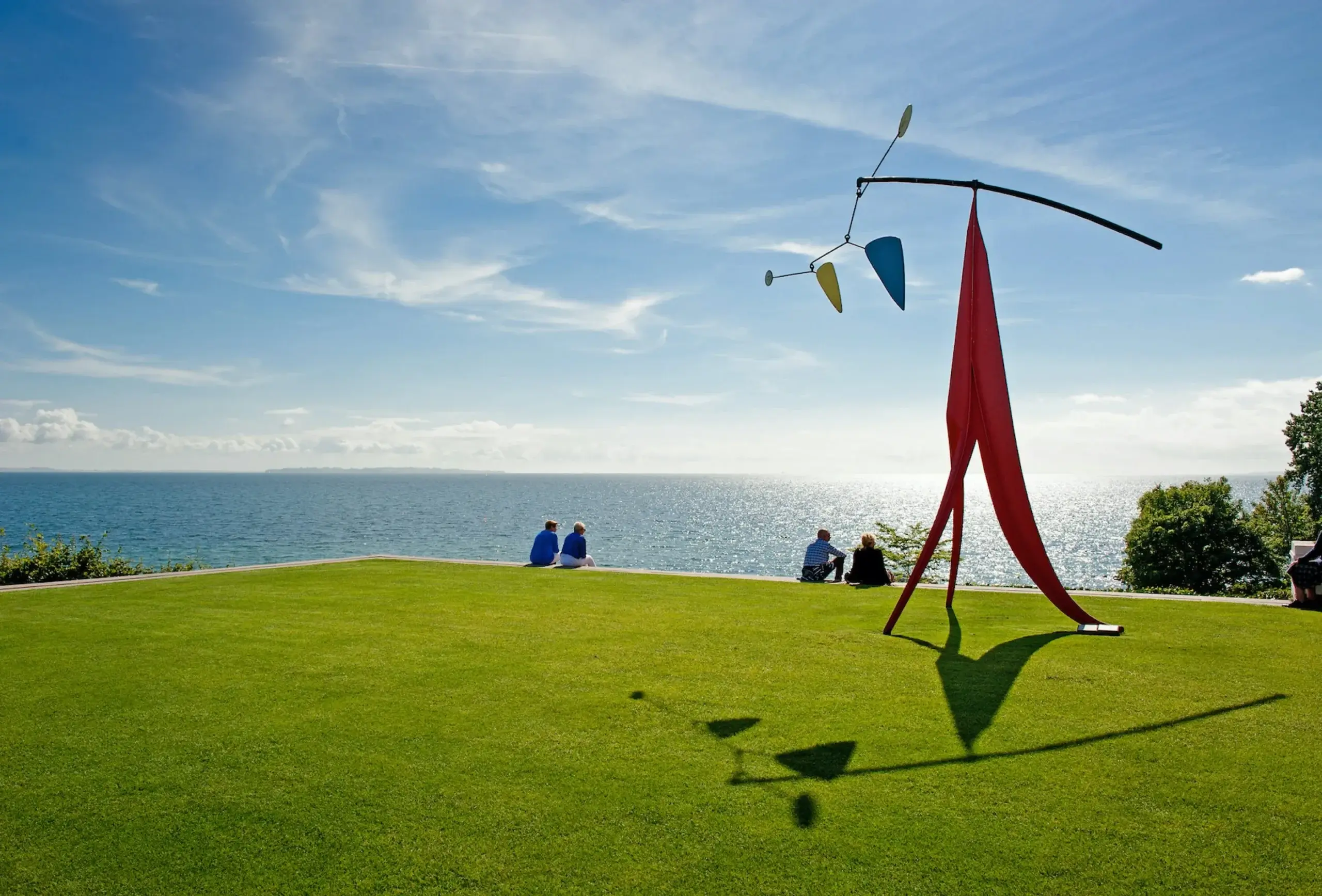
I began at the Louisiana Museum of Modern Art, in Humlebæk, some 35 kilometres north of Copenhagen, overlooking the Øresund, with the Swedish coast visible across the water. When Knud W. Jensen founded the museum in 1958, his ambition was to create a place where Danish audiences could encounter modern art, at the time still poorly represented in the country’s museums. Curiously, Louisiana was already the name of the nineteenth-century villa Jensen bought and transformed into the museum: its first owner, Alexander Brun, had named it after his three wives, all of whom were called Louise. More than anything, Louisiana embodies an idea of what a museum can be — a place where art, architecture and nature are not perceived as separate elements. Perhaps this is why, almost seventy years after it opened, it still feels remarkably contemporary.
From Louisiana’s landscape, the journey leads back towards Copenhagen and then to the opposite side of the city, to Refshaleøen, one of the places that best captures the Danish capital’s recent transformation. For much of the twentieth century, this was home to the Burmeister & Wain shipyards, once one of Denmark’s largest workplaces. Today, its vast industrial buildings house art, creative studios, music, restaurants, street food and experimental projects.
At the heart of this transformation is Copenhagen Contemporary, occupying some 7,000 square metres of the former Welding Hall, converted by Danish architect Dorte Mandrup. The sheer scale of the building allows for something that would be almost impossible in the historic centre: monumental installations and videos, performances and artworks that visitors can physically enter. Among the exhibitions currently on view — alongside James Turrell’s permanent installation, a work by Kengo Kuma and Camille Henrot’s solo show — the one that interested me most was Fire & Ice – On Belonging and Becoming in Kalaallit Nunaat (Greenland). Eight artists connected to Greenland — Martin Brandt Hansen, Emilia Sølvsten, Inuuteq Storch, Jessie Kleemann, Inuk Silis Høegh, Kim Kleist-Eriksen, Lisbeth Karline Poulsen and Julie Edel Hardenberg — explore identity, belonging, colonial memory, language and the transformation of a country everyone suddenly seems eager to talk about. The exhibition instead begins from a different premise: allowing Greenland to speak through its artists.
A third museum completes this centrifugal cultural geography: ARKEN Museum of Contemporary Art, in Ishøj, on the coast southwest of Copenhagen. Opened in 1996, ARKEN resembles an enormous ship run aground in the coastal landscape. The building was designed by Søren Robert Lund, who won the competition while still an architecture student, and the maritime metaphor runs throughout the project, from its 150-metre central axis to its porthole-like windows. Here too, the museum does not end with the building: beyond it lie the sea, dunes, beach and a sculpture park. Back in the heart of Copenhagen, Kunsthal Charlottenborg is essential. Its history dates back to 1883 and today it is part of the Royal Danish Academy of Fine Arts. It is precisely this relationship between exhibition space and academy that makes it so compelling: this is not simply a place for presenting established artists, but a point of exchange between education, experimentation and the wider art world. Its scale is surprising, particularly for a public kunsthalle in the very centre of the city, between Kongens Nytorv and Nyhavn. Its international programme sits alongside the Royal Danish Academy’s MFA Degree Show and the historic Spring Exhibition.
It was here that I noticed one of the most appealing aspects of Copenhagen’s cultural scene: openings are not invitation-only affairs. They are open to everyone, and music is an integral part of the experience. Museums almost seem to compete for the most interesting musicians and DJs, turning exhibition openings into genuine gatherings for the city. Music becomes another layer of the programme — not entertainment added to art, but part of a different understanding of what a cultural institution can be and how it relates to its public.
Of course, an art scene cannot live on institutions alone. To understand Copenhagen, one also needs to explore its private galleries: fewer in number than in other European capitals, perhaps, but firmly connected to the international circuit. Among those with the strongest international presence are Nicolai Wallner, Nils Staerk and Christian Andersen. Galleri Bo Bjerggaard is another name to note, with a roster of artists of considerable international standing. It is a relatively small ecosystem, but far more connected to the global art world than its size might suggest.
Also worth noting is Denmark’s national gallery, SMK – Statens Museum for Kunst, whose collection spans seven centuries, from the former royal collections to modern and contemporary art. With the introduction of democracy in 1849, the monarchs’ collection passed to the nation — an origin that lends particular significance to the museum’s continuing idea of itself as an art collection belonging to all Danes.
A weekend in Copenhagen inevitably leads into the territory of design — hardly a recent discovery here, but rather a historic part of the city’s cultural identity. Designmuseum Danmark was founded in 1890 with a mission that says much about the Danish relationship with design: to show objects of quality not simply to preserve them, but to educate manufacturers, designers and the public. Since 1926 it has occupied the former Royal Frederik’s Hospital, an eighteenth-century Rococo building adapted as a museum by Ivar Bentsen and Kaare Klint. Its permanent exhibition, Danish Modern, traces the extraordinary period from the 1920s to the 1970s that transformed Danish design into an international language, through figures including Kaare Klint, Finn Juhl, Hans J. Wegner, Børge Mogensen, Verner Panton and Nanna Ditzel.
In Copenhagen, however, design is not something you encounter only in a museum. It is in the chairs in restaurants, the lamps, apartments and bars, and in the materials of the buildings themselves. Few cities make it quite so apparent how profoundly the design of objects can contribute to the design of a society.
Perhaps this is also why where you stay can become part of the story. For anyone who prefers feeling at home away from home to the formality of a grand hotel, there is one place in Copenhagen I would particularly recommend: Four Suites, a house that captures the very Copenhagen idea of understated luxury, expressed through space, materials, light and design rather than display. The Harsdorffs Suite, with two bedrooms, a living room and kitchen, feels less like staying in a hotel than temporarily inhabiting Copenhagen. It is an important distinction. After a few days in the city, you realise that Danish design works best when it ceases to be something to look at and becomes something to use: a chair to sit on, a lamp switched on in the evening, a table to gather around.
But Copenhagen is perhaps best understood from the water. For centuries the harbour was part of the city’s productive infrastructure; over recent decades it has become one of the principal territories of its urban transformation. Refshaleøen retains its more industrial and experimental character, while closer to the centre the waterfront tells a different story, shaped by major works of contemporary architecture that have redefined the city’s relationship with the sea. This transformation also extends to the places where art is actually made. Art Hub Copenhagen, in its new home at Thoravej 29, adds an infrastructure to the city’s cultural landscape designed for artists before audiences: studios, residencies, production and research. Less visible than a museum, perhaps, but important in understanding how Copenhagen is investing not only in places where art is exhibited, but also in those where it can be conceived and produced.
Opposite Henning Larsen’s Copenhagen Opera House, inaugurated in 2005, Papirøen – Paper Island, on Christiansholm, is one of the most successful examples of the waterfront’s transformation. For decades, the huge rolls of paper used by Danish newspapers were stored here; later, the old warehouses became home to creative activities and Copenhagen Street Food. Today the entire area has been reimagined by COBE as a sequence of brick buildings, pitched roofs and irregular volumes that evoke, without imitating, the memory of the old harbour warehouses. Water continues to weave its way through the new development in the form of canals, jetties and public spaces.Also on Papirøen is Cecconi’s, the Italian restaurant associated with Soho House, the international members’ club that has one of its outposts here. I would not include it among the restaurants that best represent Copenhagen — both the food and its aesthetic belong to a decidedly more international world — but it is worth stepping inside for the space, and above all for the location.
If design and art have long been part of Copenhagen’s cultural identity, gastronomy is probably what has most radically transformed its international image over the past twenty years. Noma, which opened in 2003, became the emblem of the New Nordic Cuisine revolution and in 2010 reached the top of The World’s 50 Best Restaurants for the first time, turning Copenhagen into a global culinary destination. What is interesting, two decades later, is to see what that revolution has left behind: not simply a constellation of excellent restaurants, but a different culture of food, produce, fermentation and seasonality that seems to have entered the city’s DNA.
Noma reopened in August in a new setting surrounded by nature and overlooking the water, and has meanwhile entered a new phase. Noma Projects, launched in 2022, has transformed some of the research developed over the years in its fermentation lab and test kitchen into products that can travel beyond the restaurant: ferments, condiments and other culinary experiments. Its shop occupies the greenhouse next to the restaurant. Once again, we are virtually on the edge of Refshaleøen: art, post-industrial space and gastronomy end up sharing the same geography. Not far away is La Banchina, a tiny waterfront spot on Refshaleøen: a handful of tables, a sauna, a jetty from which Copenhageners dive into the water, simple food and natural wines. It may be more compelling for its setting and atmosphere than for what arrives on the plate, but perhaps that is precisely what makes it so quintessentially Copenhagen: water, wine, a sauna and a former industrial district transformed into a place for living.
A less famous restaurant well worth seeking out is Admiralgade 26, a particularly appealing example of that very Copenhagen territory somewhere between restaurant, bistro and wine bar. Set in a house dating from 1796 in the heart of the city, its contemporary cooking has a strong Japanese influence, with an emphasis on vegetables and fish and, above all, a serious interest in wine. Its cellar is shared with Ved Stranden 10, a wine bar that opened nearby in 2009. There is no conventional wine list: you talk, taste and decide what to drink together, choosing from a predominantly European selection focused on small producers and artisanal wines. Together, the two addresses show how deeply natural-wine culture has become embedded in Copenhagen’s gastronomic scene.
akmē moves in a different register: an intimate restaurant built around a seasonal menu that brings Japanese and French cooking into conversation. Here again is that almost minimalist precision that seems to run through Copenhagen from design to the dining table: few elements, an intense focus on ingredients and a highly concentrated approach to cooking.
And perhaps this is where art and food finally come together. Not simply because Copenhagen has many good museums and many good restaurants, but because over the past twenty years it seems to have built around both the same idea of a city: open, informal and accessible, deeply conscious of its identity yet continually willing to reinvent it.
Credits:
- Louisiana Museum of Modern Art.
- Louisiana Museum of Modern Art.
- Copenhagen Contemporary.
- Galleri Nicolai Wallner.
- Nils Stærk. Foto: Malle Madsen.
- SMK – Statens Museum for Kunst.
- Designmuseum Danmark.
- Papirøen – Paper Island.
- Cobe.
- La Banchina.
- Noma.
