

Art Beyond the Runway: A Conversation with Vincent Lo Brutto on Air Service Basel
Vincent Lo Brutto
During Art Basel week, exhibitions and events extend far beyond the fairgrounds, taking over locations across Basel and its surroundings. Among them is Air Service Basel, a project developed by Vincent Lo Brutto and Pablo Stahl, founders of the Paris- and Basel-based gallery Lo Brutto Stahl. Hosted within the premises of a private airport, the initiative brings together 41 artists, including both gallery artists and artists represented by other galleries. Spread throughout hangars, offices, waiting rooms, private lounges and even the basement, the exhibition unfolds within a setting more commonly associated with transit than with art. Works appear where one would least expect them: Florence Jung’s tennis balls, rackets and other tennis-related objects are scattered throughout the airport, while works by artists including Tomasz Kowalski, Carlotta Amanzi, Martin d’Orgeval and Gordon Matta-Clark punctuate a route that follows the existing infrastructure of the building. I’ve met Vincent Lo Brutto during this year’s edition to discuss the origins of the project, the gallery’s approach, and the possibilities offered by exhibiting contemporary art in unconventional spaces.
MS – Why did you decide to create Air Service Basel?
VLB – We opened the gallery almost three years ago, and from the very beginning we knew that Basel was a place where we wanted to establish a presence. At the time, we were still a very young gallery and, like many others, we were thinking about participating in art fairs. But we also felt that waiting for opportunities was not our only option. Our collaboration with Air Service Basel began just one year after opening the gallery in Paris. What started as an off-site experiment has since evolved into an ongoing project that we continue to develop year after year.
MS – How does Air Service Basel relate to the gallery programme?
VLB – It is truly an extension of the gallery. It has now become our second gallery location, where we develop an annual programme. It allows us to expand our activities beyond our space in Paris and to present works in Basel within a completely different context. We envision it as a highly experimental space and are committed to offering artists true carte blanche. We are currently developing a programme of invitations and large-scale exhibitions that fully embraces the possibilities of the space. The idea is not simply to reproduce a gallery exhibition in another location, but to create a broader dialogue between artists, artworks, and visitors. Above all, we want to offer a non-conventional space of exceptional scale, where the possibilities for artistic experimentation are immense.
MS – What interested you about working within a private airport?
VLB – They are “hyperreal” spaces, as Jean Baudrillard described them. Places where circulation, signs, and standardized environments create an experience that seems detached from any specific place or culture. Ultimately, the space transforms the way people encounter artworks. Here, you are not in a white cube, a museum, or a conventional gallery. Instead, the works enter into dialogue with hangars, offices, waiting areas, and the airport’s entire infrastructure, even with the people who work there. Every one of these elements has to be taken into account in the curatorial process. In the end, that is what makes the experience of visiting the exhibition so compelling and distinctive.
MS – The airport itself seems to play an important role in the project.
VLB – Absolutely. During Basel week, there is an incredible flow of people passing through here. Collectors arrive from all over the world, making this a unique point of convergence for the international art community. Now, especially with the third edition of the exhibition, artists are increasingly embracing the airport itself as both a site and a subject. They are creating works in direct response to the space and what it represents, including site-specific installations as well as protocol-based and ephemeral works, such as those by Bat-Ami Rivlin and Hélène Janicot.
MS – One of the most surprising aspects of the exhibition is the way artworks are integrated into the existing environment.
VLB – That is very important to us, and it has been part of the project’s core concept from the very beginning. The challenge is to create exhibitions within a space that is constantly evolving and in motion. We are not trying to transform the airport into a traditional exhibition venue. Instead, we work with what is already there. Visitors may encounter a work unexpectedly as they move through the building. Florence Jung’s tennis balls and rackets are a good example. At first, they appear to be ordinary objects, but gradually they reveal themselves to be part of the exhibition.
MS – How has the project evolved since the first edition?
VLB – The first edition was not necessarily easy to bring to life because people did not quite know what to expect. It was a new format in an unfamiliar setting. But over time, artists, collaborators, and visitors have embraced the project.
It has gradually become a discreet—still very low-key—meeting point during Basel week. Since the very first edition, every visit has been by appointment only and personally led by Pablo or myself. This naturally limits the number of visitors we can welcome each year. As a result, relatively few people have had the opportunity to experience the exhibition. It also gives us a unique opportunity to engage directly with our visitors and, above all, to offer a different pace from that of the fair itself.
MS – Before opening the gallery, you were already organising exhibitions together with Pablo. Was founding a gallery a natural step?
VLB – Yes, very much so. Pablo and I were both artists, already working on projects together and organising exhibitions. From the very beginning, our main focus was always the exhibition itself. Opening the gallery felt like a natural continuation of that process. It was not something that happened overnight, but rather the result of a shared way of working that had developed over time.
MS – Many galleries today focus heavily on the fair circuit. You seem to have taken a slightly different route.
VLB – From the very beginning, we preferred to focus on building a strong programme rather than trying to do everything at once. It felt more important to concentrate on projects that truly reflected our interests and the practices of the artists we work with. The collaboration with Air Service Basel grew out of that way of thinking. It gave us the opportunity to create our own platform and develop a project on our own terms.
MS – Lo Brutto Stahl will participate in Art Basel Paris this October. Looking back, do you think projects such as Air Service Basel played a role in the gallery’s development and visibility?
VLB – Certainly. More than increasing the gallery’s visibility, I think Air Service Basel has helped define its identity. Over the years, it has become an essential part of our programme. It has given us the opportunity to develop a year-round programme, experiment with different exhibition formats, and realise projects that would not have been possible elsewhere. I don’t know if projects like this make a gallery more visible, but I do think they make it more legible. They help people understand what you stand for, how you work, and the kind of programme you are building. For us, that has always mattered more than visibility alone.
MS – Many galleries focus primarily on the fair circuit. What do independent initiatives such as Air Service Basel allow you to do that a traditional fair booth cannot?
VLB – We never think of Air Service Basel as a fair booth. It is a group exhibition that happens to take place in an unusual venue. The airport itself creates a unique set of constraints, and those constraints are the starting point of every exhibition we develop there. At the same time, it is surprisingly open-ended. Thanks to the trust and support of the Air Service Basel team, we have the freedom to imagine projects that would be difficult to realize anywhere else. From small interventions to large-scale installations, as well as performances and film screenings.
Credits:
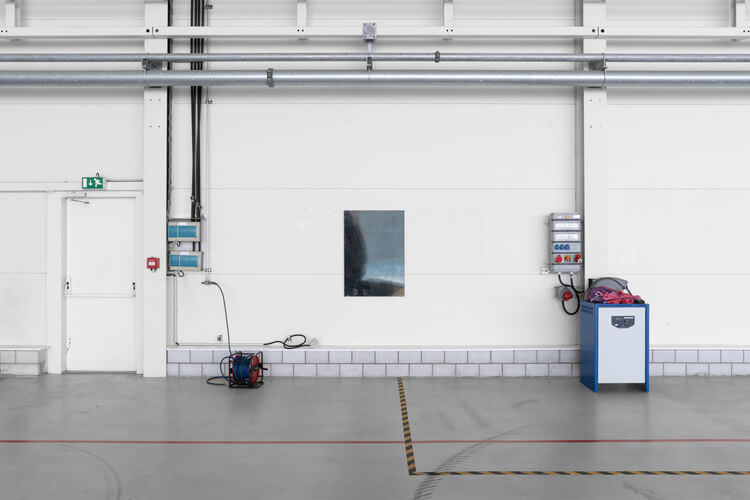
Tomasz Kowalski, Untitled, 2026. Oil, gouache and pencil on jute, 100 × 70 cm (39 3/8 × 27 1/2 in). Courtesy of the artists and Lo Brutto Stahl, Paris and Basel.
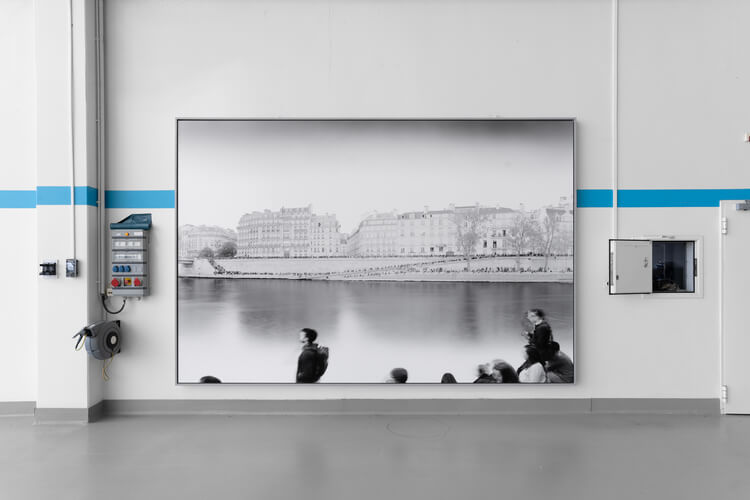
Martin d’Orgeval, Témoins, 2019. Inkjet print, wooden frame. Print: 262 × 394 cm (103 1/8 × 155 1/8 in). Frame: 265 × 397 × 6 cm (104 3/8 × 156 1/4 × 2 3/8 in). Prototype / Edition of 5 + 2 AP. Courtesy of the artists and Lo Brutto Stahl, Paris and Basel.
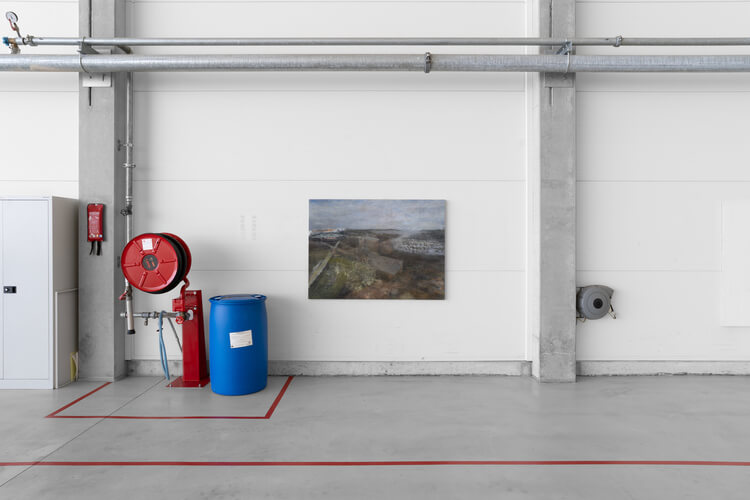
Carlotta Amanzi, Acedia, 2026. Oil, spray and metal-ceramic on canvas. 110 × 150 cm (43 1/4 × 59 in). Courtesy of the artists and Lo Brutto Stahl, Paris and Basel.
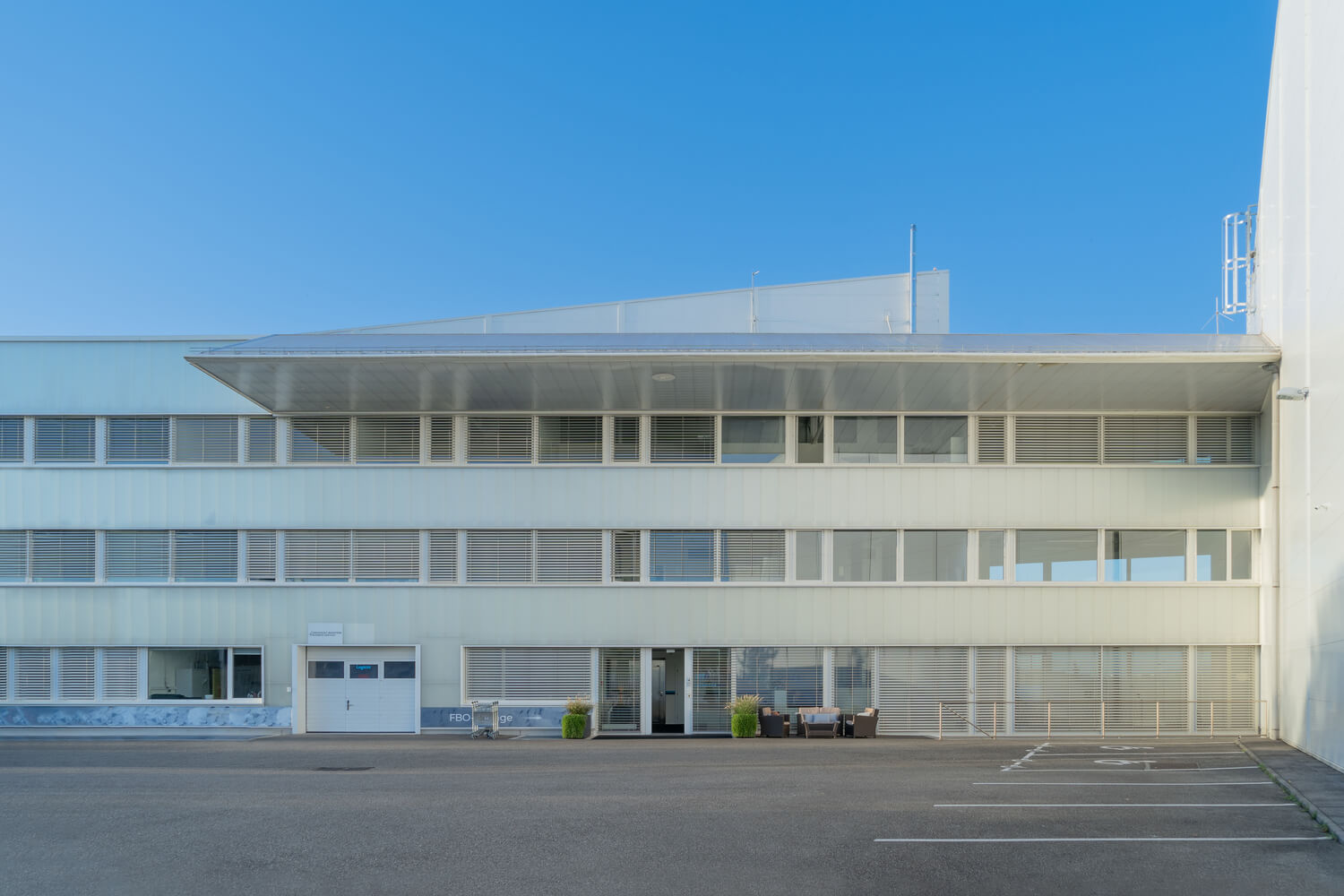
Gallery front of Lo Brutto Stahl in Basel. Courtesy Lo Brutto Stahl, Paris and Basel.
