

Cristiana Collu in conversation with Mara Sartore
Cristiana Collu
“Venice Biennale Portrait” is a series of interviews conceived and conducted by Mara Sartore, introducing some of the most anticipated figures in the contemporary art scene on the occasion of the 61st International Art Exhibition – La Biennale di Venezia. The series began before the inauguration of “In Minor Keys” under the title “Awaiting Venice Biennale 2026”. In both its phases, collectors, curators, artists, and directors engage in conversations exploring their roles, upcoming projects, and their relationship with Venice.
In this conversation, Mara Sartore meets Cristiana Collu, Director of the Fondazione Querini Stampalia, to reflect on Venice and the evolving role of cultural institutions within the city. Taking place against the backdrop of the Biennale Arte, the discussion focuses on Collu’s vision for the foundation and its ongoing transformation through “The Dreamer”, a project that reimagines the museum’s historic spaces as a dynamic narrative between memory, imagination, and civic responsibility.
MS – The series of interviews I am carrying out was born from the idea of taking advantage of the visibility of the Biennale Arte to reflect on Venice and on the transformations it is undergoing, listening to the voices of those who have chosen to live and work here, especially in the cultural sphere. In your case, I imagine that the candidacy for the direction of the Fondazione Querini Stampalia also represented a life choice: moving to Venice and imagining a project for one of the most vital places in the city, which for many – also because of its library – is almost a Venetian microcosm. I would therefore ask you: what pushed you to make this choice? How did you imagine your life here before arriving, and how was it transformed in the first two years of Venetian experience?
CC – I would say first of all recklessness and unawareness. I did not project expectations, and that is very much in my nature: I prefer to let myself be surprised by places. Having a predefined idea risks becoming a prejudice, or an expectation destined to be disappointed. I, instead, want to listen to places and let them suggest to me what to do.
Venice, in this sense, has been – and still is – overwhelming. A continuous surprise, for its mutable beauty, which truly reveals itself only by crossing it in all seasons. Living it also in winter, one deeply understands Iosif Brodsky and his Watermark: An Essay on Venice: one recognises images, references, visions that are part of our cultural memory, but which here acquire a completely different density.
I remember an episode, many years ago, around 2010: I was in Venice for an errand and, going out toward evening near Piazza San Marco, I found myself immersed in very thick fog, the caigo. Nothing could be seen. It was an almost mystical experience, very intense. Reliving it today, as a resident, it had the same force.
I am very interested in this emotional dimension linked to movement: emotion, after all, literally means “to move,” “to be moved”. As I recently wrote, that “tear of beauty” evoked by Iosif Brodsky is almost an excess pressing to emerge. Venice overflows with beauty, and it is an overflowing that must be traversed: a “too much” that should not be reduced, but inhabited, because it is precisely there that the city reveals itself with greatest intensity.
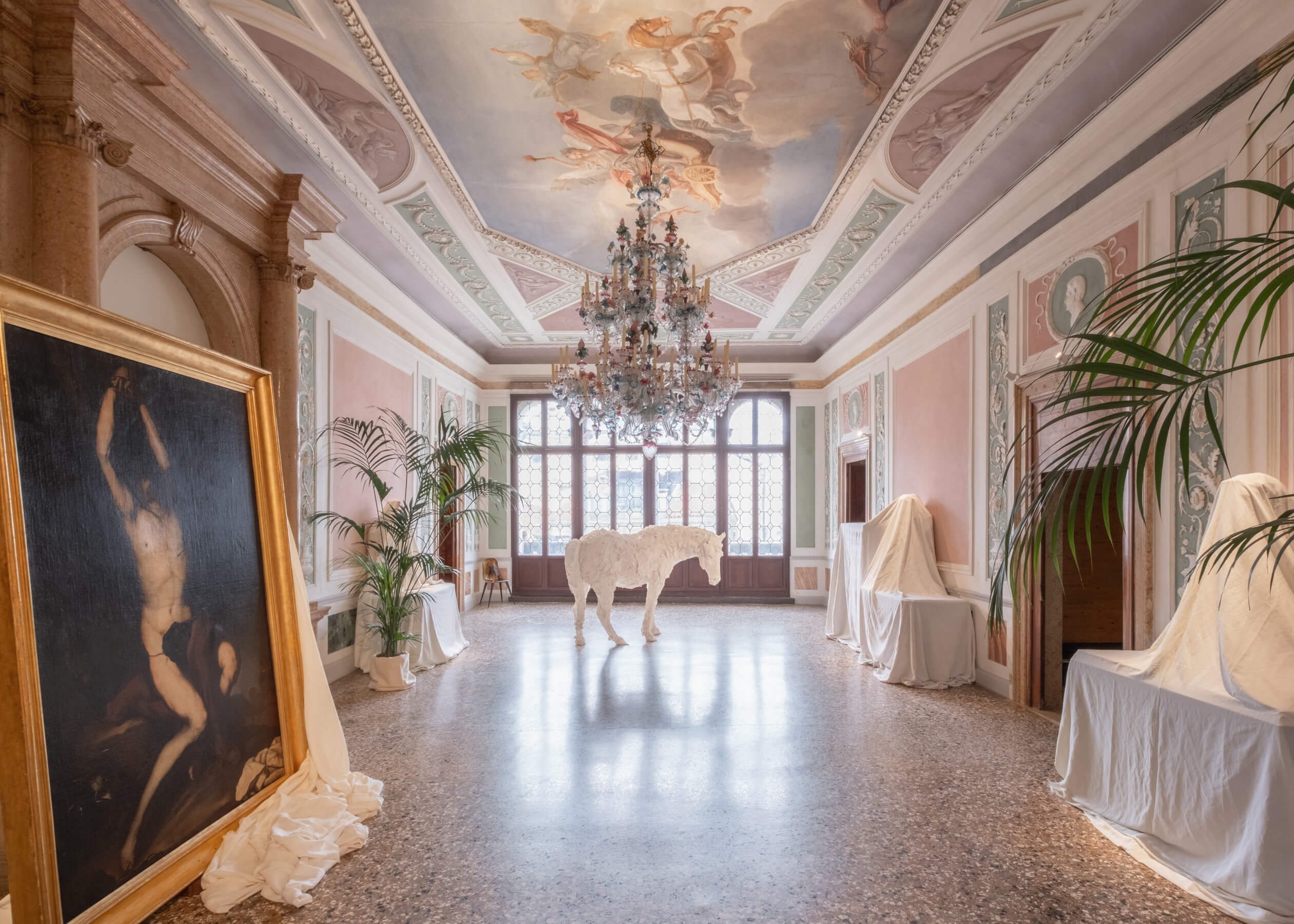
MS – The new program opens on May 5, the birthday of Giovanni Querini, a symbolic date that this year coincides with the days of the Biennale Arte. After the first intervention on the common spaces – entrance, shared areas, bookshop, and third floor – you now present a new transformation, concerning the second floor, historic heart of the museum and seat of the permanent collection, completely rethought in the project The Dreamer. In the presentation text, the link between dream and responsibility emerges strongly. Starting from this, I would like to ask you: how do you imagine the future of Venice?
CC – The new installation presents itself almost like a temporary exhibition: it is one of the possible configurations of the space, conceived to remain open to change. I believe it is fundamental to introduce “revolutions”, because change is what opens possibilities and makes tools available, even when they are not yet completely defined. It is, ultimately, the condition of the dreamer.
The Dreamer takes its title precisely from this figure, whom I identify with Giovanni Querini: not only a visionary or a pioneer, but someone who was able to imagine Venice starting from Venice itself. A city that nourished him – in its liquid, unstable nature, constantly moving – and within which he projected his own aspirations, giving them back to the community.
His choice not to marry and to leave everything to the community is, in this sense, a radical gesture. His legacy is not only material – although today visible, for example, in the library of the Fondazione Querini Stampalia, which in Venice is simply “the Querini” – but it is also a legacy of thought: an idea of future and shared beauty.
To dream in Venice means confronting one of the most fragile and complex contexts. For this reason the dream, here, is inevitably political: it carries responsibility. It means taking charge of one’s own visions and their consequences. Without imagination, one ends up adopting the visions of others; having one’s own vision, instead, is already a first step toward bringing it into being. As Walt Disney used to say, “if you can dream it, you can do it”; and, more cuttingly, Stanisław Jerzy Lec: “an idea? To have one”. But dreaming is not enough: it is necessary to understand the implications of what is imagined, and know how to set limits. It is there that the dream truly becomes aware – and therefore responsible.
MS – If you were to close your eyes, how do you imagine Venice in twenty years?
CC – I hold a two-sided image. On the one hand, I would like it to remain exactly as it is; on the other, I know that will not be possible. The idea of preserving things unchanged, almost embalming them, does not belong to life. What matters, rather, is knowing how to accompany processes of transformation.
MS – There have been moments when Venice was more open to transformation, architecturally as well. This is shown, for example, by Carlo Scarpa’s intervention here at the Fondazione Querini Stampalia, carried out between the late 1950s and early 1960s, in a very different context from today’s. Over the past twenty years, much has been invested in conservative restoration – often tied to the conversion of palaces into hotels – and, aside from interventions such as the Ponte della Costituzione by Santiago Calatrava, new projects have been rare and only marginally oriented toward innovation. In your view, should Venice reopen a more courageous dialogue with the contemporary? And can it still be a living polis, with a real social dimension, despite its growing spectacularisation?
CC – I believe so, and the Venetian community proves it, including many Venetians by adoptions. There is a very strong cultural fabric here, with broad and diversified interests. At the same time, Venice is also made of “resistant nuclei”: a condition that is precious on one side, yet on the other signals fragility, because one is always resisting something – I am thinking above all of the issue of housing.
The need for protection is real, but it can turn into an excess of caution, which ends up compressing those energies capable of generating the future. It is a reflection that we also addressed at the Fondazione Querini Stampalia, engaging with different perspectives: from more alarmist positions to scholars and scientists who analyse the city through data. It is precisely from this exchange that the need emerges to find a balance between protection and capacity for transformation.
MS – You hosted two meetings in the series titled “Abitare Venezia” (“Living Venice”), dedicated to the Venetian population between past and present. The initiative is promoted by the Association Progetto Rialto, with the support of Lineadacqua, and carried out in collaboration with the City of Venice, as well as numerous cultural institutions. What reflections emerged from them?
CC – “Abitare Venezia” is first of all a reflection on the very meaning of inhabiting a city like this, a theme very dear to our vice president, Donatella Calabi. In the same way, professor Andrea Rinaldo often reminds us how forecasts on the future are far from reassuring: according to some scenarios, sea-level rise could seriously endanger Venice in the long term. It is not a matter of alarmism, but of exercising responsibility. Speaking about these issues means recognising the gravity of the situation while, at the same time, asking what may still be possible. Perhaps we can still imagine – and build – a Venice capable of crossing this critical passage, rethinking the way we inhabit and relate to the territory.
MS – Returning to “The Dreamer”, can you tell us what we will see, and how you conceived the reorganisation of the permanent collection spaces?
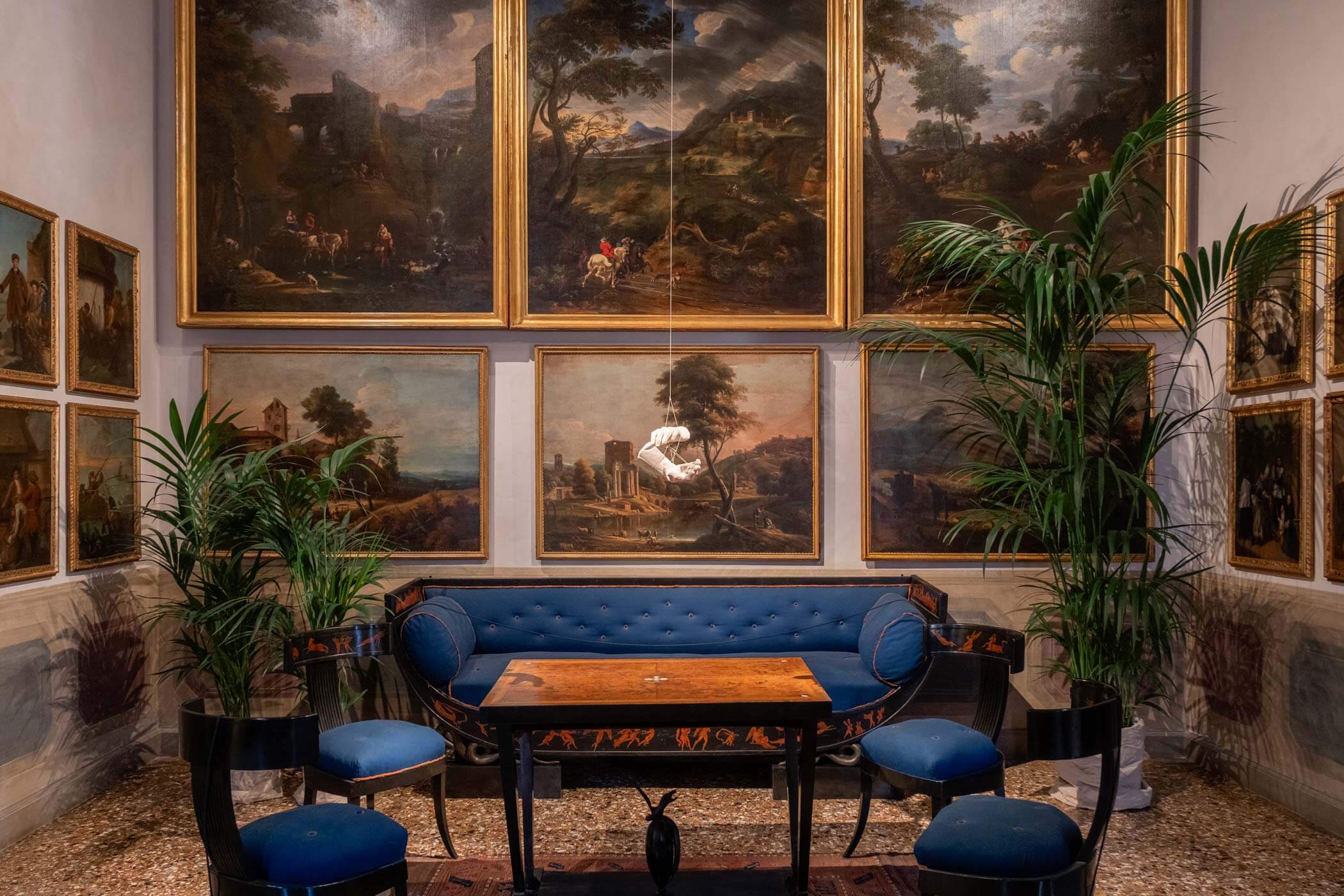
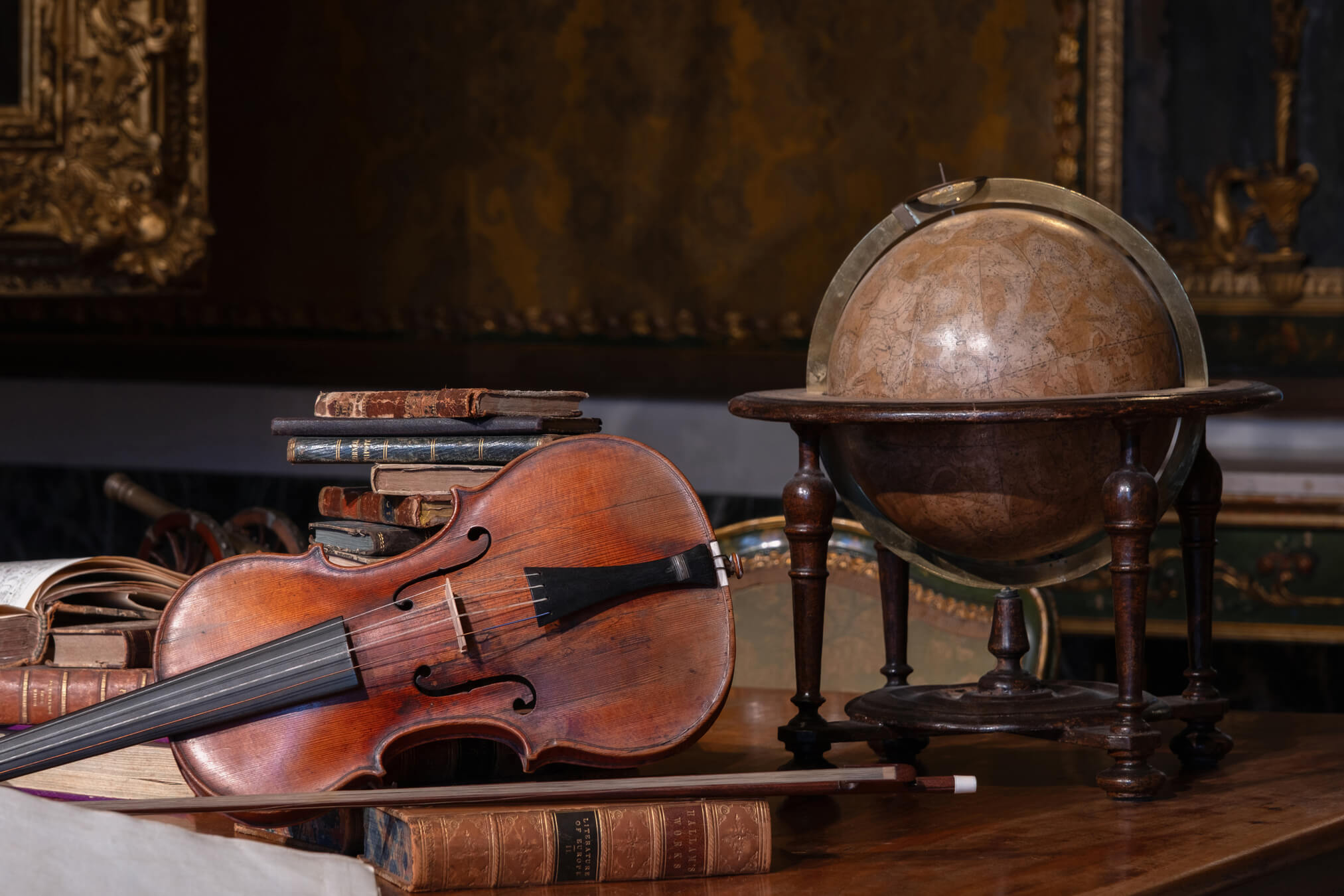
CC – I’ll start from the beginning: my relationship with the second floor was a complex one. It is a highly stratified space, suspended between museum and home, with a nature that is not entirely philological, and which raised a number of questions. At first I moved cautiously, because every transformation generates reactions – at times cautious, at times critical. Then, however, I felt the need to intervene more decisively. I conceived this floor in cinematic terms, as a sequence of sets. My point of reference was Senso by Luchino Visconti: an imaginary world coherent historically as well, given that Giovanni Querini died in 1869 and the film is set a few years earlier. Certain elements already present in the space helped me build the project as a narrative around Querini’s figure, beginning with his dreams and also lesser-known aspects of his life: his passion for fencing, for horses, alongside his interest in books, silk, and many other things.
In redefining the spaces, the idea of movement is central. I wanted the rooms to be traversed like cinematic environments, in which one perceives a vital presence, constructed as experience. It is an aware form of fiction: an artificial reconstruction that restores a perceptual truth.
Naturally, every project must confront concrete limits – resources, constraints, context – and the need to maintain narrative coherence. What emerges is a path that crosses different eras, also reflecting the long history of the Querini family, whose origins date back to the sixteenth century. But time here is not only chronological: it is a layered time, almost suspended, as happens in dreams.
MS – In your exhibitions, time is often overturned. Let me ask, then: did you give in to the temptation to insert contemporary works in dialogue with the collection?
CC – The Querini collection is already, in itself, a place where five centuries coexist. In the house-museum, every object carries with it a layering of stories. I chose to insert five contemporary presences, almost embedded there – I would even say concealed: precise interventions, distributed across seventeen rooms, entering into resonance with what is being narrated. They are Emanuele Becheri, Chiara Bettazzi, Giusy Calia, Daniela De Lorenzo, Silvia Giambrone, Davide Rivalta.
MS – Looking ahead: after the intervention on the second floor, what will the next developments for the Querini be?
CC – The project unfolds in phases. In 2025 I worked on the ground floor and the Campo, both literally and symbolically: it was important to reaffirm the Fondazione’s presence in the city, make the entrance more welcoming and dynamic, and strengthen the bond with the public space of the Campo – the meeting place par excellence. The aim was also to overcome the separation between public and private, reactivating a dialogue. The Querini is, first of all, Venice’s library, frequented above all by students, who represent the city’s future.
I then intervened on the third floor, previously occupied by the collection of Intesa Sanpaolo and now restored to its exhibition function through a project by Michele De Lucchi. This intervention fits into a continuity of contemporary stratifications ranging from Carlo Scarpa to today. In this context also falls my intervention on a work by Giovanni Bellini, conceived as an ephemeral gesture, which also provoked some critical reactions.
The Dreamer, on the second floor, was conceived not as a definitive installation but as an open and modifiable system, capable of evolving over time, in keeping with my past experiences such as Time is Out of Joint at the Galleria Nazionale d’Arte Moderna e Contemporanea. The installation thus becomes a dynamic device, able to welcome new configurations and generate ever-changing narratives.
The library floor will undergo renovation beginning at the end of 2026, thanks to funding from the 8×1000 funding. It will never, however, be closed to the public: a temporary relocation to the fourth floor has been planned, and that floor will in turn be enhanced. It is a space still little known, but destined to fully become part of the overall project. Over the course of three or four years, the Fondazione’s new identity should take complete shape.
MS – In your manifesto, at one point, you introduce a reflection on dream in relation to responsibility and the future. You also associate, if I remember correctly, the idea of dream with a political dimension, speaking of a “political dream”. I consider this a particularly central passage: could you expand on it and clarify in what sense dream can take on political value?
CC – For me, it is fundamental to place the word “dream” beside “political”. Doing so means recognising a profound disconnection that exists today. We live in a kind of torpor, often justified by reasons we know well – too much to do, lack of time, difficulty in understanding and translating what is happening around us. I believe we have grown used to relying on “translators”, on someone who simplifies reality or tells it on our behalf. And yet collective dreams exist, even when they have not yet been made explicit. Sometimes what is needed is a voice capable of naming them. In this sense I inevitably think of the famous “I have a bream” by Martin Luther King Jr.: his dream was in reality the dream of many. And it is precisely this collective dream that can activate latent energies present in each of us.
It is in this sense that dream becomes political. If what I imagine for my city is shared, if we are able to intercept a widespread desire, then it is no longer merely an individual imagination: it becomes a political fact. But dream is political even when that community does not yet exist. As Sara Ahmed suggests in Living a Feminist Life, sometimes one must assume the role of the killjoy, the spoilsport: remaining faithful to what one considers essential, even when it is not shared or recognised. Not becoming detached from what one feels to be necessary.
This is particularly true for those who work in cultural institutions, where one often feels the burden of having to justify one’s role, as though it were something secondary. In reality, it is precisely there that this responsibility – political as well – is played out most urgently.


