

Mario Codognato
Mario Codognato
“Venice Biennale Portrait” is a series of interviews conceived and conducted by Mara Sartore, introducing some of the most anticipated figures in the contemporary art scene on the occasion of the 61st International Art Exhibition – La Biennale di Venezia. The series began before the inauguration of “In Minor Keys” under the title “Awaiting Venice Biennale 2026”. In both its phases, collectors, curators, artists, and directors engage in conversations exploring their roles, upcoming projects, and their relationship with Venice.
In this conversation, Mara Sartore meets Mario Codognato, who reflects on returning to Venice after many years and shares his vision for the Berggruen Foundation. Located at Palazzo Diedo, the foundation aims to connect with both the local community and an international audience through exhibitions and public events. By engaging with Venice’s unique character while maintaining a global outlook, the foundation seeks to keep the city culturally vibrant throughout the year, complementing existing institutions and enriching the cultural offer beyond the Biennale.
MS – As a Venetian who spent many years away from the lagoon before returning eight years ago, I would like to open the interview with a reflection on the city. If you were to compare Venice today with the Venice of your childhood, what changes do you see most clearly?
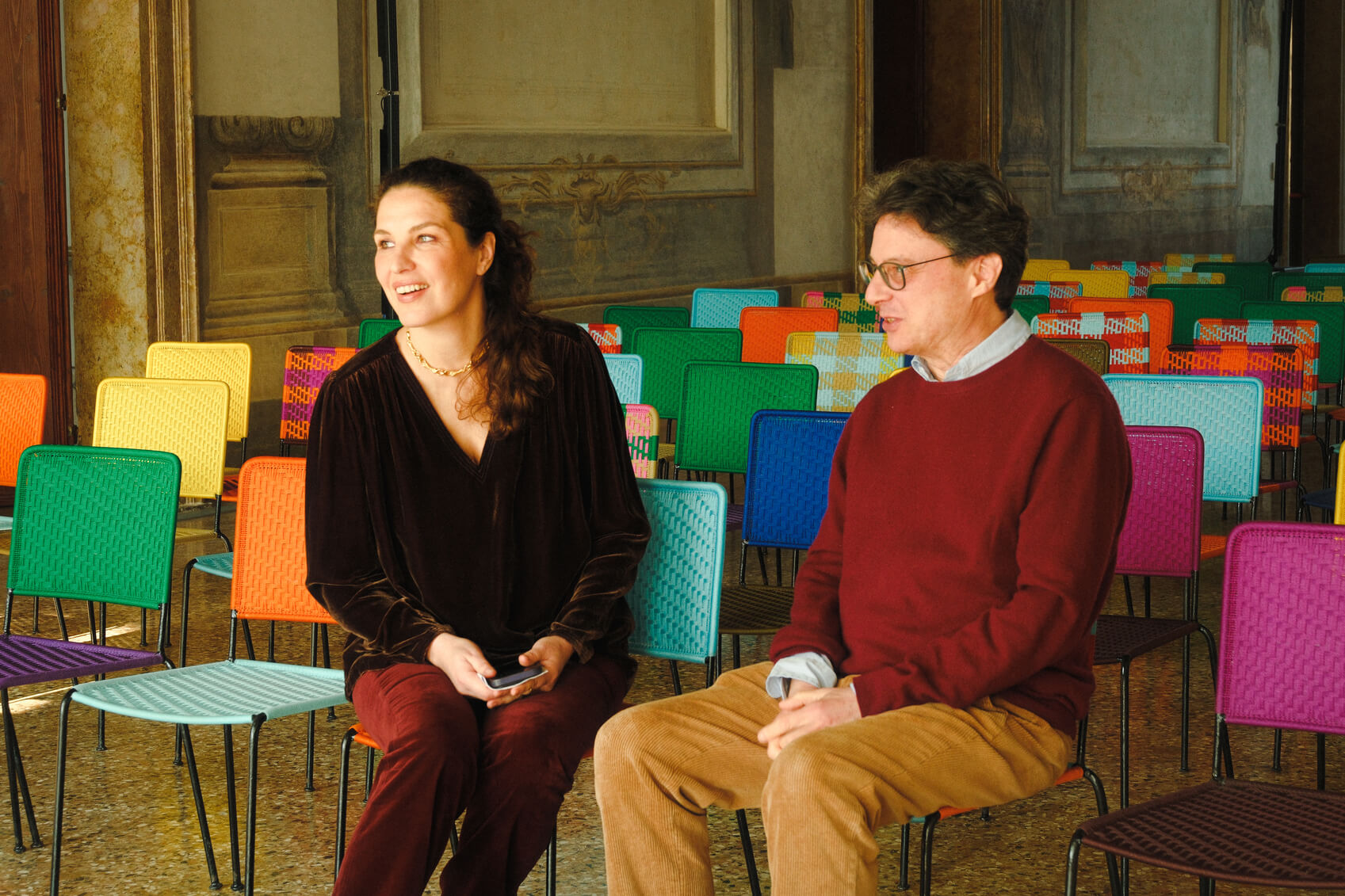
MC – My childhood obviously dates back half a century, so there have been changes not only in Venice but in the world as a whole. In fact, the real difference is not so much compared with the city of my childhood, but rather with the city I left when I was a bit older. I was born in the 1960s and I belong to a generation that, in a sense, experienced a kind of diaspora: many of my contemporaries, myself included, left the city when we reached adulthood. Many never returned. If you had asked me ten years ago, I would probably have told you that I would not come back either. This is perhaps the biggest difference: the city has become very depopulated. A simple example: we are here at Palazzo Diedo, which for a hundred years was a primary school. I went to primary school here. At a certain point the school was closed because there were no longer enough children. In a way, this sums up one of the major changes in the city.
MS – And what was it like for you to return to Venice?
MC – As I said, I never imagined I would come back. For various reasons, including personal ones, I had to return, and then I was fortunate that some opportunities presented themselves, including the one we are talking about now. I must say that I am happy to have returned, because the city has changed for the better compared with the one I left, especially in terms of cultural activities. People often ask me what the main driver of this change has been. In my view, a very important decision was to extend the Biennale from spring through to autumn, instead of concentrating everything only in the summer months. This created a chain reaction: today cultural activities in Venice, many of them of extremely high quality, are spread across almost the entire year. I remember winters in which the city would really sink into the dimension of a small provincial town, while at other moments it would become the epicentre of many things. Today that contrast has softened, and I think it has been a very positive change.
MS – What role do you think foundations can play in Venice, given that there are now more and more of them? Will there come a time when they will also be expected to play a role in the social life of the city?
MC – I believe, or at least I hope, that we will get there. Naturally it will be a gradual process. We ourselves are a very recent foundation: we opened only recently and we are still trying to understand how best to position ourselves. We have tried to think of initiatives that could also appeal to people who live in Venice. The real question, however, is: who actually lives in Venice? If we consider only the historic centre, we are talking about around 40,000 people. That is a very small audience. If we think only of the six sestieri, it is clear that the potential public is limited. If, on the other hand, we widen the perspective to the metropolitan city, then the situation changes. But even there, a great deal of work still needs to be done. And then one should also consider the wider territory: for example Padua, which has a large university population and therefore an interesting young audience.
MS – If you were to close your eyes now and imagine Venice twenty years from now, how would you see it?
MC – If I were an optimistic person, I would say that I hope everything we have been talking about will continue to develop. But since I am not particularly optimistic, I think there is still a long way to go. In twenty years’ time we will probably witness very profound changes.
MS – Do you think anyone will still live here?
MC – I certainly hope so. However, I do not think the number of residents will grow again very much. It is quite a particular situation, though not entirely unique. I noticed this while living in other historic Italian cities: there is a very strong historic centre and then a city that expands around it, and between the two there is often a certain distance. It is difficult to overcome this urban structure and involve a wider territory in the life of the centre.
MS – And yet, precisely because Venice is such a particular island, don’t you think it might be experiencing a small reversal of the trend, with some people returning to live in the city?
MC – Yes, certainly. In that sense everything has improved compared with the city I left, and I hope things will continue in that direction.
MS – Let’s talk about Palazzo Diedo: it was purchased by Berggruen, then there was a long restoration lasting more than two years, and now that you are open and active, what is the relationship between the foundation and the city, and what are your plans in relation to the city?
MC – I think it is important for institutions like ours – which is still very young: we opened only recently and we are still somewhat in the process of building ourselves – to move in two directions. On the one hand it is fundamental to address the city, because it is right and important to create a bond with the territory. Even if, as I said earlier, the potential audience is relatively small and therefore not sufficient on its own to sustain an activity with international ambitions. On the other hand it is inevitable to look outward as well, because Venice is a city with a very strong international dimension. The right balance, in my view, is precisely to try to hold these two directions together: to build a dialogue with the city while at the same time maintaining a presence on the international scene. The local reality, however, is very particular. Venice is made up of many micro-realities that do not always communicate with one another. It is a city that has the characteristics of a small town, like many others in Italy with a similar population, but at the same time it is a place that people all over the world feel they must visit at least once in their lives and that hosts cultural institutions of the highest level. This double nature makes it very unusual. The challenge is to find a dialogue that can speak to both of these dimensions.
MS – Have you already tried to do something in this direction?
MC – In our small way, yes. This winter, for example, we had initially thought of remaining closed, as many foundations do during the quieter season. Then we asked ourselves what we could do to make ourselves better known also to those who live in the city. We realised that many Venetians did not really know what this place was: for many residents of Cannaregio it was simply the old school. At a certain point I remembered something from many years ago. I had visited a museum in Zurich and, in the middle of the exhibition route, there was an ice-skating rink. It was quite a strange experience but also very interesting. So we decided to invite Olaf Nicolai and install a skating rink here. It was a project that also had an artistic dimension, but at the same time it was something playful and accessible. The result was surprising: an enormous number of people came, of all kinds. Many entered the building for the first time. Some had come here as children when it was still a school. It was a very interesting experience. If even a portion of those people come back to see an exhibition, that will already be a great result.
MS – Can you tell us what you will present at the next Biennale?
MC – We are working on a project curated by Hans Ulrich Obrist together with Mat Dryhurst and Holly Herndon, who are a couple both in life and in art and who work in Berlin. They are among the pioneers of a certain type of artistic practice that uses artificial intelligence. This curatorial triumvirate is preparing an exhibition entitled Strange Rules, dedicated precisely to themes related to artificial intelligence. It is still a work in progress and, given the nature of the artistic practices involved, also quite experimental.
At the same time we will present a small exhibition – small in terms of scale – in tribute to Ceal Floyer, who passed away prematurely last December. It will be a selection of works spanning her career.
At Casa dei Tre Oci, we will present an exhibition dedicated to Joseph Kosuth, which will open in March and run until the end of November, therefore for the entire duration of the Biennale. Kosuth has had a very strong relationship with Venice: he lived here for many years and also created several permanent works in the city, including the neon piece on the façade of the Fondazione Querini Stampalia and the work in the Aula Magna of Ca’ Foscari.
MS – I would like to ask you a question about Nicolas Berggruen: when did you meet, and why do you think he chose Venice?
MC – We have known each other forever. His father was very good friends with my father and our families often spent the summer in Venice, so we used to see each other when we were young. Then for many years we somewhat lost touch. I was closer to his brother, who was closer to my age, and in the meantime I had moved elsewhere. When Nicolas began looking for a European base for the Berggruen Institute – which has offices in Los Angeles and Beijing – he thought of Venice not only because of his personal connection with the city, but also because of its symbolic position, in some sense halfway between East and West. When he learned that the Tre Oci were for sale he called me to ask my opinion. That is how everything began. At a certain point I also told him about Palazzo Diedo, which I knew was on the market. We came to see it almost out of curiosity. But Nicolas immediately sensed the potential of the building, also because of its rather unusual volumes for Venice. He had long had the desire to create a foundation dedicated to the visual arts, in addition to the more philosophical work of the Berggruen Institute, and from there the idea took shape very quickly.
MS – What are the future projects of the Berggruen Foundation in Venice?
MC – I would like this to become a place that is alive all year round, as far as logistical and economic possibilities allow. This year, for example, we will also present a theatre project that I care about very much: an unpublished play by Samuel Beckett performed by an Irish company specialising in his work. The performance will last six hours and the audience will be able to move freely within the building, entering and leaving the scene. We also recently organised the presentation of Yasmina Reza’s new book and the turnout was incredible; there was almost no space left for people. I would like to continue developing this kind of initiative alongside our main activity, which of course remains the production of exhibitions. Events, talks, theatre, literature: all activities that can keep the building active throughout the year. Perhaps even another skating rink.


