

Markus Reymann
Markus Reymann
“Venice Biennale Portrait” is a series of interviews conceived and conducted by Mara Sartore, introducing some of the most anticipated figures in the contemporary art scene on the occasion of the 61st International Art Exhibition – La Biennale di Venezia. The series began before the inauguration of “In Minor Keys” under the title “Awaiting Venice Biennale 2026”. In both its phases, collectors, curators, artists, and directors engage in conversations exploring their roles, upcoming projects, and their relationship with Venice.
In this conversation Mara Sartore meets Markus Reymann, director of Ocean Space in Venice, where he reflects on its evolution from a boat-based research platform developed within TBA21–Academy to a permanent site for artistic and scientific inquiry in the Venetian Lagoon. Reymann discusses Venice as a living laboratory where art, ecology, and activism intersect, and presents Ocean Space’s research-driven programming, including Tide of Returns and “Nature Speaks”, which explore the rights of nature and the legal recognition of ecosystems.
MS – We are here at Ocean Space in Venice. My first question is very simple: this is an “ocean space” in a lagoon. Why do you think Francesca Thyssen-Bornemisza wanted to open Ocean Space in Venice?
MR – It’s a very good question. Inside the foundation TBA21 Thyssen-Bornemisza Art Contemporary, we started TBA21–Academy, which is the programming entity of Ocean Space, in 2011. In the beginning, it was based on a boat. The idea was to look at the ocean from the ocean – not looking at it from a distance and doing work about it, but really from within it. At some point, though, we realised that constantly moving around – and creating programmes that also moved, not necessarily by boat but across different locations – made it difficult for people to read the programme, to understand what it was.
So we started thinking about where we could actually situate ourselves. At the time, the Academy had moved from Vienna to London, and we were considering the big European centres – places where you don’t have to explain the relationship between art and science, art and environmentalism, art and activism, contexts where these connections do not require constant explanation. But eventually, we came to Venice.
Venice, with its history of being at the intersection of exchanges – ideas, goods, spices – has always been a dynamic place of knowledge production, of invention, of engineering: everything you need to build a place as fantastic as this city. And then there is something else: Venice has this very particular habit of reflecting on itself and the world through the language of contemporary art, and it has done so for more than a hundred years.
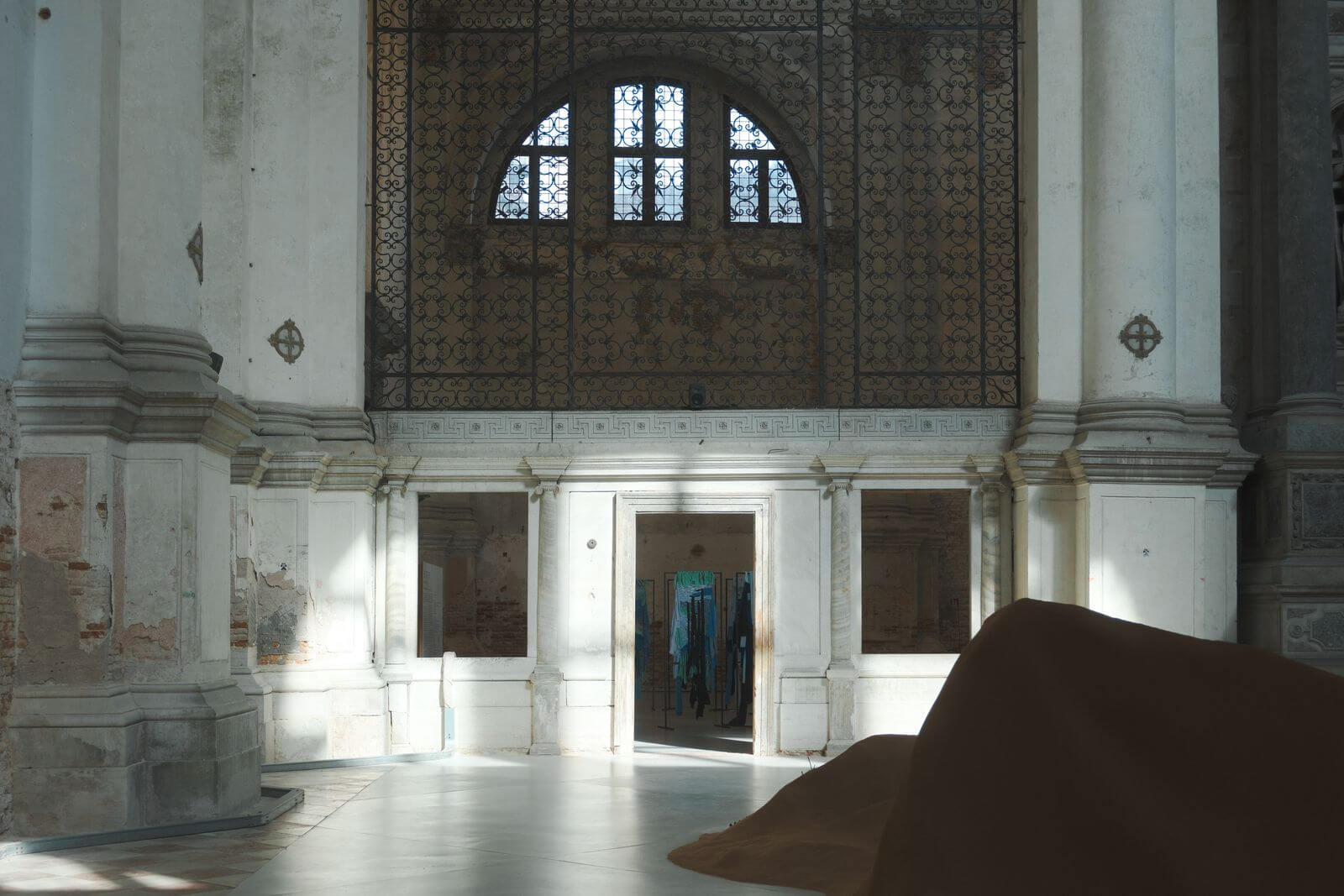
After many iterations of thinking, Venice was clearly the best place. Not only to think about the ocean from the ocean, but also thinking about the ocean while floating within a lagoon. We started renovating Ocean Space, in the former Chiesa di San Lorenzo, in 2015 already, four years before we opened the space.
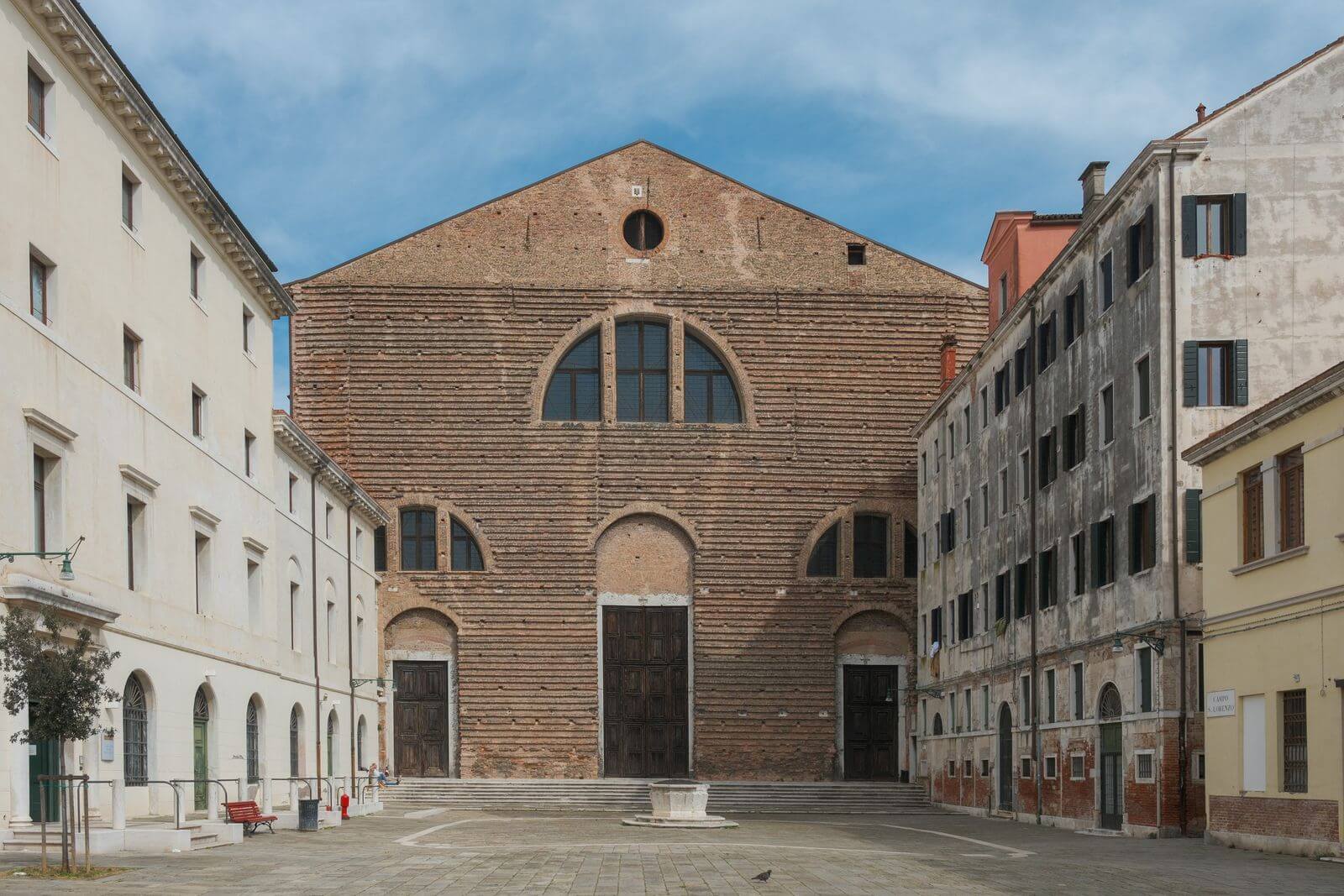
MS – You have always been the director of Ocean Space. Since its opening in Venice, you have been coming here regularly – and now you live here.
MR – I’ve been coming here since 2015, during the renovation. Then of course, since 2019, when the space has opened more consistently. And since last week, I’m officially a resident of Venice.
MS – What is your relationship with Venice?
MR – My relationship with Venice is still one of absolute wonder. I have been here countless times, and every time I come back, I think: this is impossible, it’s impossibly beautiful. It’s a place of absolute wonder, of beauty and inspiration – and, obviously, of challenges. In many ways, it is a microcosm of the world.
MS – Yes, I always say that Venice is a microcosm for the macrocosm. It’s like a mirror. It is often described as overexposed, fragile, slowly emptied of its inhabitants. There is this recurring refrain of Venetians saying that each year we are less and less. What do you see in the present and future of Venice?
MR – When I arrived, someone said to me: for every two people that come, fourteen leave. It’s a recurring narrative about Venice. During COVID – when we first had the possibility to start moving around the city again – you could really see how few people were actually living in the historic centre. I think this kind of business model – where you can make so much money out of the city being nearly empty, renting space every night, every day – is a dangerous one.
That said, I do think Venice has a quality of life that people don’t see, because they see so much of the tourism. Behind that, there’s a quality of life that is extraordinary. And not just extraordinary, but literally out of the ordinary. You live in the lagoon: the way you move around, the way that you move with the tides, with aqua alta. It’s really exceptional. And I see that it becomes more and more attractive to a lot of people. There’s an economy to that which creates difficulties – it becomes prohibitively expensive. But on the other hand, it defies a certain logic: it’s so attractive that people want to be here. At some point, politics will have to come to a reckoning: is Venice meant to be a living city, a museum, or an attraction? And I think they will come to the conclusion that it needs to be a living city.
Because, as you said, Venice is a microcosm of the macrocosm. And if you address its challenges – in terms of economics, socio-economics, but also the environment – then you have an incredible living laboratory for the greater challenges the world is facing.
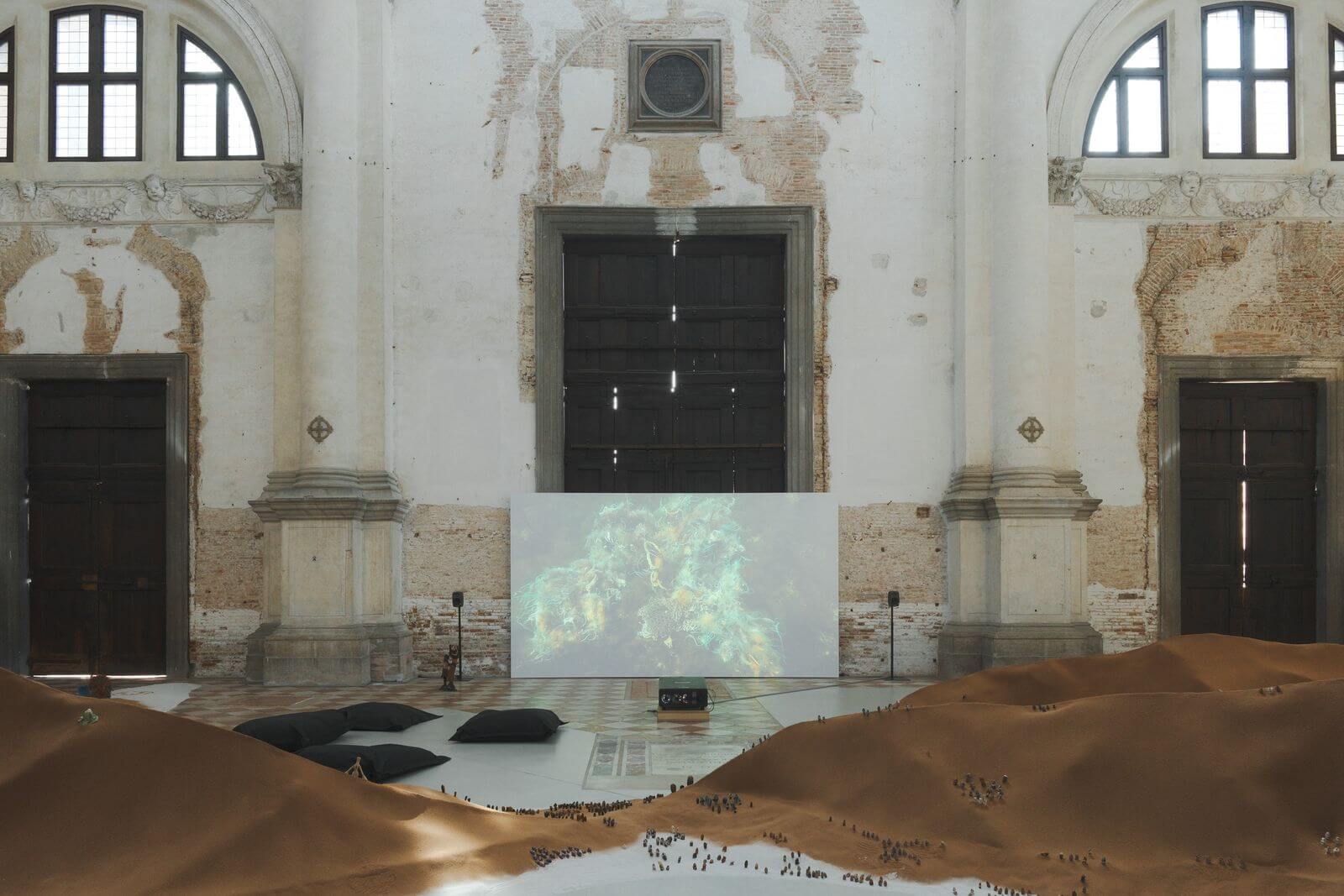
MS – From an environmental point of view, and carrying on this idea of Venice being the microcosm of the macrocosm, how can the city represent this global moment of ecological crisis?
MR – Living here and being closely involved with the renovation of this space, one understands how difficult it is to do any form of intervention in a place that is entirely classified as heritage. I think we need to really reconsider what heritage means. Venice is Venice because it was once the pinnacle of ingenuity – building these incredible palazzi in a lagoon that was never meant to have these buildings. Yet, now it seems that we are a little paralysed by this idea of heritage that needs to remain what it has always been. Think about energy: you can’t have solar panels on a roof. But look at this roof: one of the biggest ceiling spans in Venice. The energy that we could create from it is incredible, but it is not permitted. At some point, we need to think about what it means for heritage to be fixed in time, especially in the context of environmental transition.
Beyond that, there are issues like sea-level rise, the eutrophication coming from all the farmlands – Venice is a relatively small space where so many of the challenges we face converge. At the same time, Venice has three universities, and an incredible intellectual capacity that flows through every year. The potential to think with and from Venice is incredible.
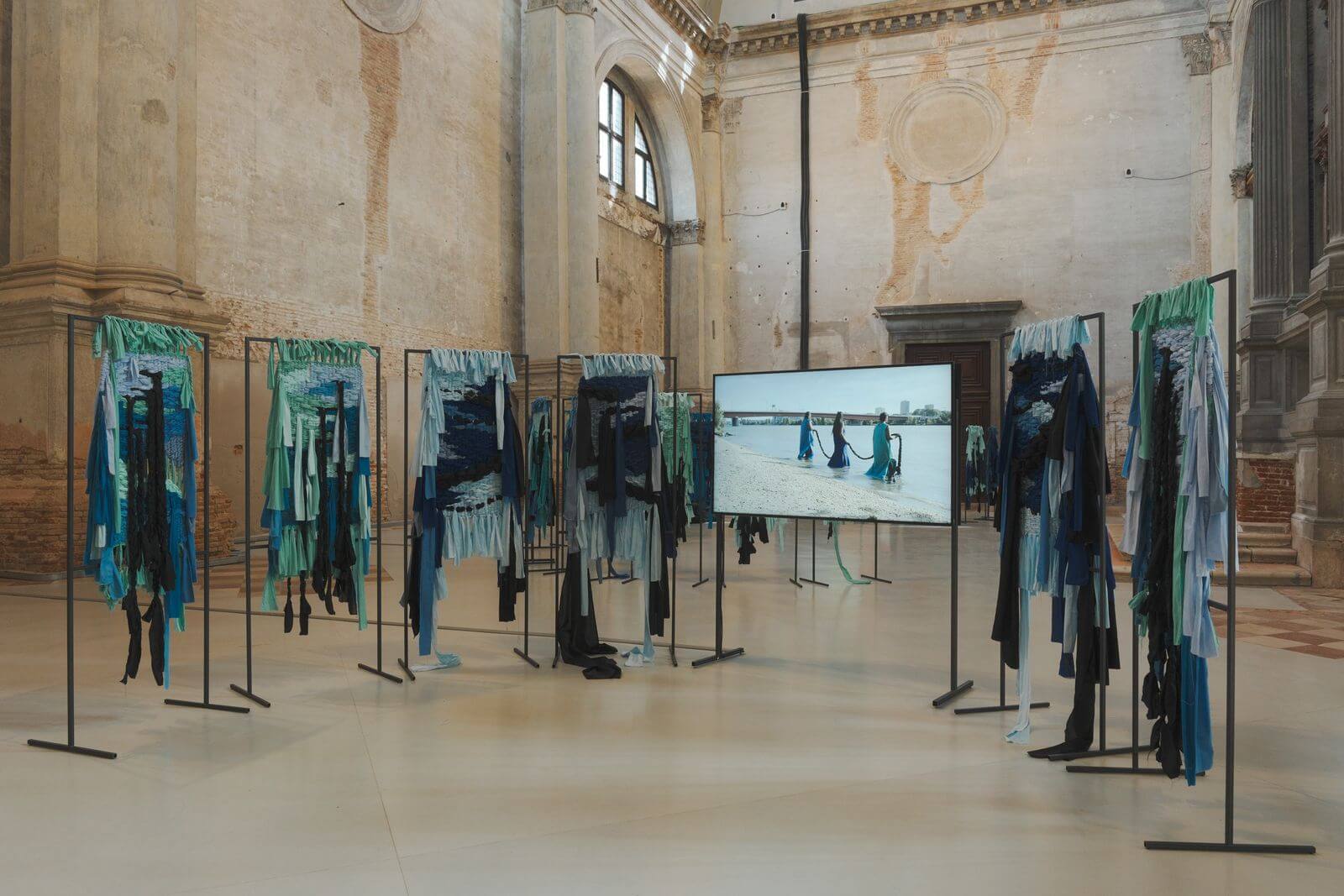
MS – In your practice, the ocean is not just an environmental issue, but a way of rethinking how we relate to the world. How can art actually function as a medium in this sense – not only raising awareness, but also producing a different form of knowledge?
MR – If you go swim in the ocean, you give your body to it. You float, and you will always be moved – it’s very difficult to be still, to be fixed. Most people immediately feel a sense of connection to everything that is happening around them in the ocean. And I think this is a way of rethinking our connection with the environment and also to ourselves.
The role of art in this, for me, goes way beyond exhibition-making or awareness-raising. Historically, artists have been given positions in our society that allow them to reflect on the world somehow from the outside. And today, we see more and more artists that look at existing systems and propose different ones. If you think about history, we started making art thousands of years before we started farming. The capacity to create symbolism – to generate shared ideas that then enable collective action – preceded civilisation. We didn’t create art because we had built civilisations. It’s the other way around. Art – and creating meaning, and creating symbols for this meaning – has been a defining factor of what it means to be human. And yet, it has now somehow been relegated into something that is purely ornamental or metaphorical, while science, politics, and the economy are prioritised. Art and culture come last in that sense.
Art gives us the possibility to look at the world differently. And the beauty of artists is that one doesn’t have to be part of a certain establishment to make art – which means that we see perspectives that are completely erased from the mainstream. But beyond that, they have a capacity to imagine possible futures that we rarely allow ourselves within the confinements of disciplines. Artists also bring people together in ways few other practitioners can. There is a universal curiosity towards them. They act as charismatic magnets: connecting disciplines, stitching knowledge systems together, and presenting them in non-prescriptive ways.
You come here, to this space, and have a completely different experience to mine, and we can have an exchange about that. The art space allows us to stay in that conversation, whereas in a political space, we have created a culture where disagreement leads people to simply leave and not engage. Art enables us to see different perspectives, to integrate different knowledge systems, and to transfer that knowledge through experience – which then inspires action. The common assumption is that we just need more data, more knowledge, and we’ll do the right thing. But that’s not what happens.
MS – This resonates with the idea that culture is key to Venice’s future. Do you share this idea that Venice could be the laboratory for a new kind of cultural and economical model – one that invests in culture not as a business, but as a system that can also cultivate new generations and create real sustainability?
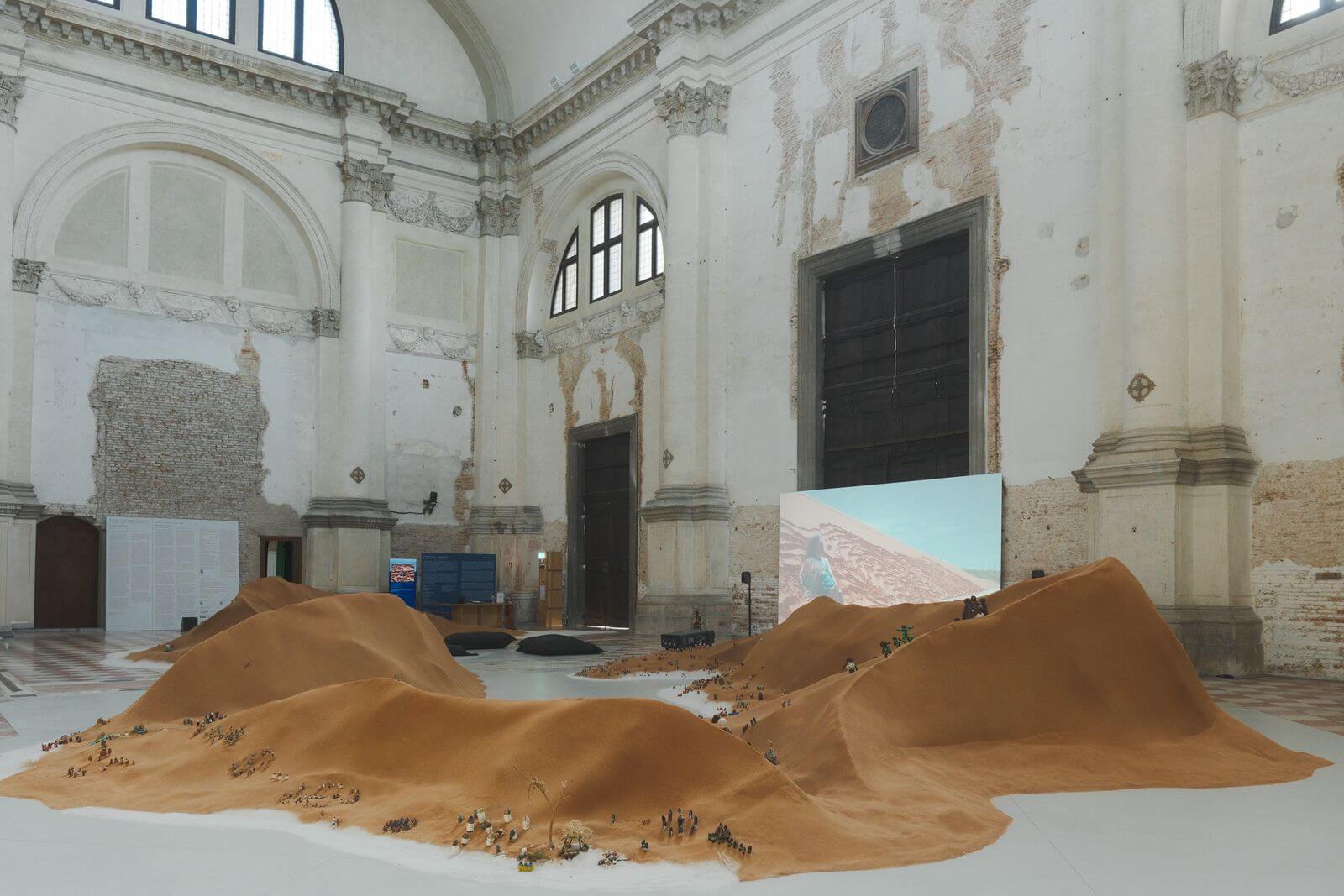
MR – Absolutely. And there’s something that people generally miss about art and culture: the innovation potential that is in it. We brought sand dunes from Namibia and northern Australia to Ocean Space, which came with many challenges that needed to be solved – and it was the artists that somehow found creative solutions. Artists have always been pushing the boundaries of technology: making pigments, figuring out how to create sculpture, and now working with technologies in ways they were not intended to be used. The potential for disruption and innovation in working with artists is completely underexplored, I would say.
MS – How do you think artificial intelligence will interfere with this power of art to activate our creativity and our relationships?
MR – Artificial intelligence is obviously a huge topic right now. It will undoubtedly displace so many workers, especially white collar workers and people who mainly work on screen. People are really afraid of what it will do to creativity, but I’m not so worried about that. Artists will use it more and more as a tool, and as a co-creative tool. At the end of the day, it might enable creativity in completely different ways than we currently imagine.
The most critical questions, for me, concern how these systems are built: how are these large language models trained, and what are they trained on? How are people remunerated for what they’ve created? How do people participate in the models being built, rather than simply having their labour and creativity consumed and digested? And then there’s the environmental impact – the use of fresh water and energy for data centres, where those centres are located, who is exposed to their consequences.
I don’t think that artificial intelligence will displace creativity. There has been a large study in which participants were shown a number of works – some created by AI, some by humans – without being told which was which. Within the top results, several were made by AI. But once it was declared that it was AI, people changed their minds. There remains a profound appreciation for things made by humans, and for interpersonal contact. What is perhaps more worrying is that there is more and more scientific knowledge suggesting that generations that grow up completely plugged in and digitally immersed actually feel more comfortable and secure in virtual connections than in real life ones – which is quite scary.
MS – Going back to Ocean Space, you said it was born on a boat as a research platform. How is it operating now?
MR – We are no longer using the boat. A space like this – even without climate control: as you can feel, it’s cold – still has a big environmental footprint, and we didn’t want to run two large infrastructures with such a substantial ecological impact. But the work remains still very much research-based. We created formats like “The Current”, a curatorial fellowship programme with three-year research cycles. We host residencies here regularly. The exhibition presented now, “Tide of Returns”, is also the result of a three-year research project.
So it’s always research-based, but now more situated in specific places. Here, obviously, the lagoon is very important as a research site. In Spain, we have a format called “Organismo”, with five case studies decentralised all over the country. We have a presence in Jamaica, where we have a residency programme and work with a sister foundation, the Alligator Head Foundation, a marine conservation organisation working on coral and mangrove restoration, turtle protection, seagrass preservation, watershed management, and enhanced livelihoods for local fishing communities. So it remains collaborative, research-based, and always with artistic practices at the centre.
MS – The exhibition “Tide of Returns” engages with the repatriation of cultural objects and histories shaped by colonial extraction. How does this project connect to Venice and to the ocean?
MR – “Tide of Returns” is by a collective called the Repatriates Collective, a group of artists and researchers who have been working together for five years, investigating the methodologies around repatriation. They come from Northern Australia, from Aboriginal communities; from Namibia and Angola; and from the West as well. Verena Melgarejo Weinandt grew up in Germany, but she has Bolivian ancestry – she is positioned within a diasporic context, in a sense. And it’s exactly in this unconventional make-up of artists that defines how they work: as a collective – very much depending and demanding this collectivity – with individual voices coming out. Khadija von Zinnenburg Carroll, the curator of the exhibition, is also the initiator of the Repatriates Collective and has been working on these topics for a very long time.
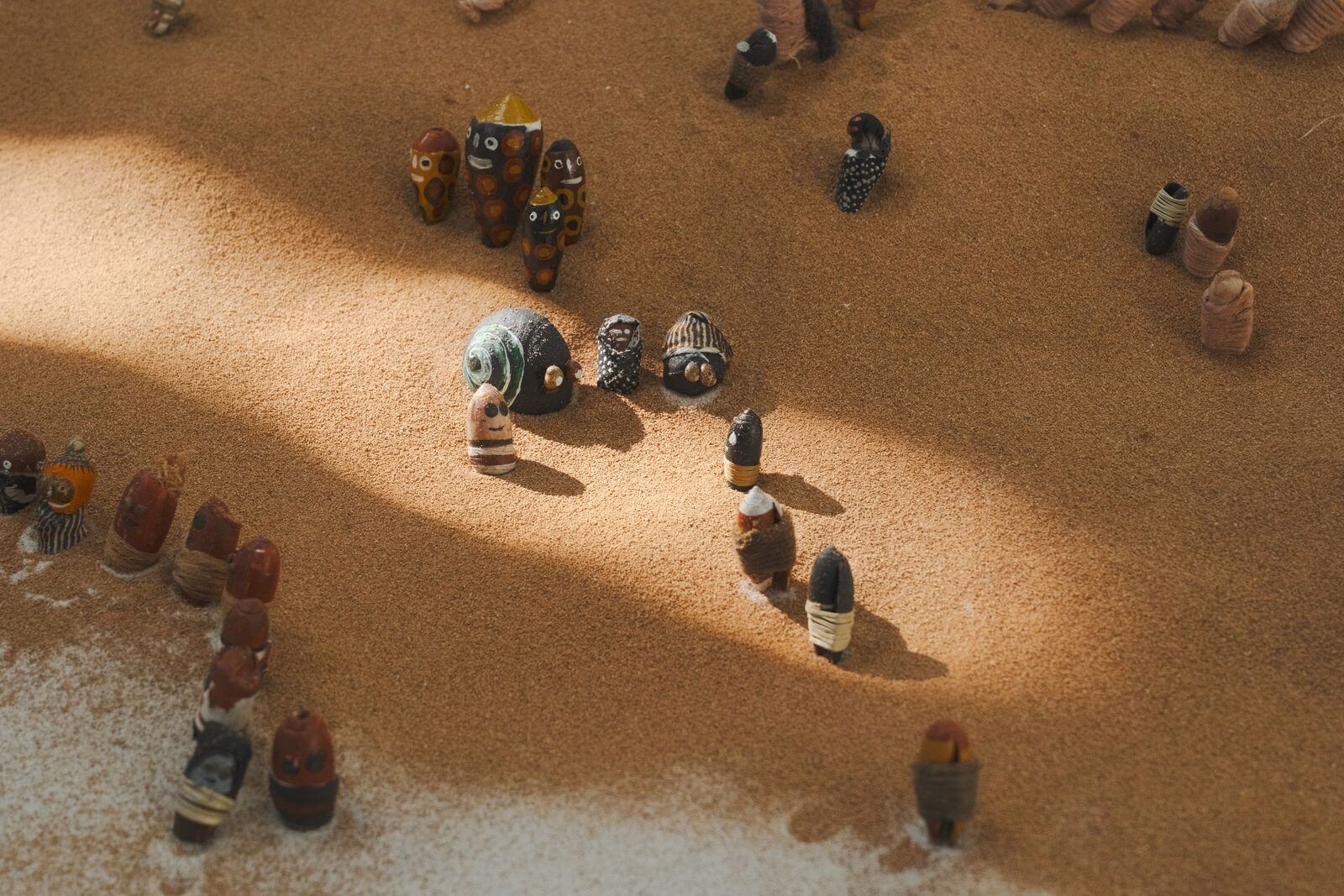
The project is centered, in part, around the practice of doll-making. In the first space, there are three dolls that come from a historic collection formerly held in Liverpool, and now repatriated back to Northern Australia. The community in Northern Australia has generously lent us these three dolls, but only for a short period – they have been gone for so long that now they don’t want them to leave again for any extended time. And there are also concerns related to climate control and conservation.
As for the connection to the ocean: many of the origin stories and myths embedded in the dolls – and there are approximately 3,500 dolls across the first space – have the ocean as their leitmotif. It is the origin of everything for these coastal communities. In Verena’s work, the ocean is a motif of connection and reconnection. There is also a lot around braiding – the process of making, unmaking, and remaking relationships. The ocean here is, again, the great connector of everything.
MS – Could you tell us about the performances that will take place at the opening?
MR – Two performances. First, a smoking ceremony to ritually and ceremonially open the space, led by Noeleen Danjibana Lalara (senior member of the indigenous community of Groote Eylandt and lead doll maker) e Annabell Demalmerrangguma Amagula (senior member of Anindilyakwa centre). Then, a performance, a poetry reading “The Moon says they are in Venice” by Samson Ogiamien. He is from Benin – the ancient Kingdom of Benin – and comes from a family that makes the casts for the Benin bronzes. He made the little sculptures that you can see around the altar. He recently performed at the Gropiusbau in Berlin, and in Basel, in Switzerland – where they have just returned a number of bronzes to Benin.
As for why we do this in Venice – Venice has always been at the intersection of exchanges and connections. So I think it is a great place to open this conversation about repatriation: what does it mean? What are the methodologies and the thinking around it? How do you remake relationships that have been severed or that have been dormant? It’s an important conversation to bring to Venice.
MS – Absolutely. And you’re also presenting the project “Nature Speaks”, about the recognition of the Venetian Lagoon. Can you tell us more?
MR – “Nature Speaks. Listening for Rights of Nature in Venice and Europe” sits in the broader idea of rights of nature – giving personhood rights to ecosystems. The first ecosystem in Europe to have been recognised with legal personhood is the Mar Menor, a lagoon in Spain. We’ve been investigating this idea for three years now, together with NICHE – the Centre for Environmental Humanities at Ca’ Foscari University, that has co-produced the initiative. And as part of that work, we initiated a European network called the Confluence of European Water Bodies. It began with the Embassy of the North Sea, Ocean Space, and the Mar Menor initiative. There are now thirty-six cultural organisations that have become members of this network. The goal is to achieve representation for all bodies of water within the European Parliament, and currently thirty-six rivers, lakes, lagoons are applying for legal personhood.
For the Venetian Lagoon specifically, what this would mean in practice is that the lagoon, as an ecosystem, regains personhood rights – which means you can hold people legally responsible for environmental crimes committed against it. It’s an ongoing process, at least two years in now. What we do is provide Ocean Space as an infrastructure for the citizens, initiatives and associations that have already been working on this recognition. It’s a small policy lab based on research we have been doing collectively with other associations, but it also becomes a space for citizen assemblies and citizen science. Later in the year, we’ll have two citizen assemblies on the rights of the lagoon and rights of nature, along with a series of workshops.
