Barbara Prenka, “Making myself at home”: The Unstable Shape of Belonging
As part of My Art Guides’ ongoing series of dialogues with artists featured in the Vetrina project at Vino Vero Venice, we are pleased to present an interview with artist Barbara Prenka. Curated by Mara Sartore, the Vetrina project transforms the display window of Vino Vero into a dynamic platform for contemporary art, inviting women artists to activate the space with site-specific works.
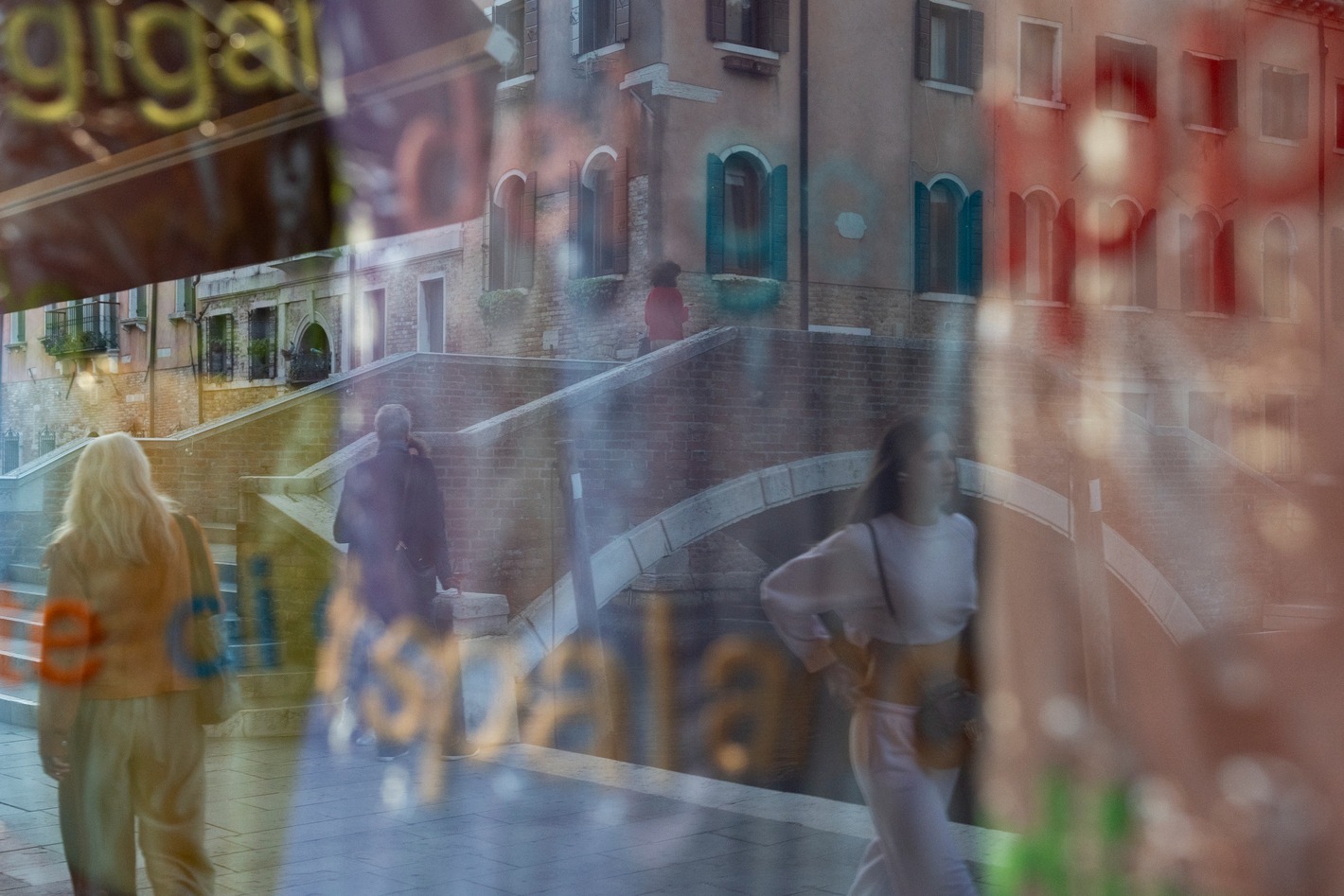
For Vetrina#18, Prenka presented “Making myself at home”, an existing work realised during her residency at Lottozero in 2025 and reconfigured for the space of Vetrina. Measuring 450 cm in length, the work folds and turns back on itself to fit a window just 227 cm wide, remaining whole but never fully visible at once – a condition that becomes a reflection on belonging and adaptation.
Barbara Prenka
Mara Sartore – You were born in Kosovo and studied painting at the Accademia di Belle Arti in Venice. Today you live and work between Italy and Kosovo. How has your journey through different places, cultures and histories shaped your artistic identity and the way you understand the notion of belonging?
Barbara Prenka – I believe the notion of belonging arises precisely when a sense of belonging can no longer be found. When a person is forced to leave their place of origin, for reasons of survival, poverty, war or other circumstances, they find themselves immersed in an entirely new reality, in which it is not always easy to recognise themselves. Tensions then begin to emerge between the identity built in the place they come from and the new one they have to confront. It is a kind of identity shock, because from one moment to the next you find yourself living between what was familiar until shortly before and something you do not yet know and must adapt to. I think my reflection on belonging grows precisely out of these constant tensions. Over time, I have come to see belonging not as something stable or definitive, but as a necessarily unstable condition, one that keeps changing in relation to the places, people and experiences we pass through. This condition is also part of the way I think and work as an artist.
MS – Your research often starts from the observation of everyday gestures, objects and materials, things we tend to take for granted and rarely pause to consider. What interests you about this seemingly ordinary dimension, and how does the process of transforming these elements allow you to question our perception of reality?
BP – I think our relationship with the world is also built through the things we touch and use every day. The objects I choose are often tied to memory, both personal and collective, but also to routine. I am interested in the way these objects, through use and through the experiences of those who own them, accumulate meanings that go beyond their original function. Take quilted blankets, for example. We associate them with rest, protection and care, but they can also hold stories, habits and traditions. In my work I start from these meanings and recreate the blankets through a more painterly process, built up through layers of marks and matter. Recreating them is also a way of returning to those memories, trying to understand them and asking myself new questions. What interests me about transformation is that an object can retain its symbolic value even when it loses the function it was created for. A blanket can go on evoking protection without necessarily protecting us. When I present it in a different form, the way we can relate to it changes too, and we are led to question what it represents and the meanings we attribute to it, often unconsciously.
MS – Creation, destruction and reconstruction seem to be recurring processes in your work. How do these transformations intertwine with your reflection on memory and identity? And to what extent does your personal story connect with a broader, collective dimension?
BP – In my work I often start from something that already exists: a surface, a fabric or an object. Through cutting, sewing, embroidery and the layering of materials, I take it apart and reconstruct it. I am interested in observing how it changes during this process and what new forms it can take. For me, reconstruction is not an attempt to recover the original form. When I cut a surface and sew it back together, that surface will never be the same again. The seams do not hide the cuts; they become part of its structure. It is also through these operations that I work on memory and identity, without treating them as something to be preserved intact. My personal experience inevitably comes into play in the choice of certain objects. The blanket, for example, has a specific meaning in my own story, but I do not want the work to be limited to telling it. I am interested in using this object to also speak about migration, about what it means to leave a place, to be without one, or to try to belong somewhere. These are questions that start from my own experience, but they do not concern me alone.
MS – In Making myself at home, the work has to physically adapt to the dimensions of the exhibition space, folding back on itself and inevitably leaving part of itself hidden from view. This spatial constraint becomes a reflection on belonging and adaptation. How did this work come about, and what does the idea of feeling at home, or of finding your place, mean to you?
BP – Making myself at home stems from a reflection on what it means to adapt to a new place, and on how much this process can affect the way we present ourselves to others. When we arrive in a different context, we try to understand its rules and habits and to find a way to become part of it. But this also entails an ongoing negotiation between who we are and what the new context is willing to accommodate. Some of the things we carry with us, such as language, traditions, habits and rituals, take on a new form, while others remain more hidden. This does not necessarily mean they are lost; they are still part of us, but keeping them hidden for a long time can eventually lead us to alter them, or even to lose them. I tried to give concrete form to this condition through a blanket that exceeds the dimensions of the exhibition space. In order to fit, it has to fold back on itself, adapting to a space that already has precise limits. Some parts of the text remain visible, while others overlap or are concealed. What interested me above all was this contradiction: the blanket manages to fit entirely into the space, but to do so it has to change its shape and give up showing some parts of itself. Nothing is left out, and yet not everything can be seen. For me, feeling at home means being able to recognise yourself in a place without necessarily having to hide what you carry with you.
MS – Vetrina brings art into an unconventional context, in direct contact with everyday life in Venice and with viewers who are not necessarily part of the contemporary art audience. Having studied in this city, what relationship do you have with Venice today, and what possibilities do you see in presenting your work outside traditional exhibition spaces?
BP – I have experienced Venice as a kind of international village, where on a walk you might stumble upon something unexpected, but also upon something you expected to find. I studied and lived there for several years, and I keep going back. I have never considered Venice a small city; quite the opposite. I think that precisely because it is so particular, and at times difficult to live in, it manages to spark a great deal of imagination. It is a city that constantly pushes you to reinvent yourself, and I believe this is especially true for artists, but also for the people who live there every day. As for Vetrina, I like that the work can also be encountered by someone who was not looking to see an artwork. Perhaps one person walks past it every day, another stops out of curiosity, and yet another does not notice it at all. It is a different relationship from the one that forms in a gallery, where you usually walk in already knowing what you are going to see. What matters most to me is that the work can also be seen by people who do not move in contemporary art circles. When I saw the window, I deliberately chose to bring a work much larger than the space available. I wanted to find out what would happen by putting the blanket in relation to those dimensions. So it was not simply a matter of finding a way to make it fit, but of using the limits of the window to open up a different conversation, and to give the work a meaning other than the one it might take on in other spaces.