

Leo Frontini: Painting from the Subconscious in Unsettled Times
In this conversation, Frontini reflects on unraveling as both process and metaphor, the subconscious as a generative space for images, and the role of imagination as refuge, resistance, and renewal in a time marked by unrest.
Leo Frontini
“Yields of Fray” carries a layered ambiguity: “fray” as conflict and unraveling, “yields” as both harvest and surrender. How did that tension guide the making of this body of work?
The tension suggested by the title became a foundational force in the development of this body of work. While creating the exhibition, I turned inward, examining the structure of my own practice. I wanted to loosen my attachment to a fixed theme or direct conceptual focus, as these can sometimes limit expression. The idea of “fraying,” like unraveling twine, became a metaphor for this intentional, meditative process, an opening up rather than a constraining. It allowed me to give way to the subconscious, letting each work emerge from and inform the next without imposed direction. The “yield,” understood as both harvest and surrender, is the outcome of this release. I let go of rational control in favour of a more intuitive state. In doing so, I aimed to create scenes that carry a sense of escape, where form and meaning emerge through unraveling rather than resolution.
The subconscious is central to your practice – memories, dreams, figures slightly out of reach. You have described the work as operating on three levels: fantasy in the making, symbolism and references from the present entering the process, and reality intervening again for the viewer. How do you navigate that layering – is it something you construct consciously, or does it emerge on its own?
There isn’t a precise order to how the work evolves. Instead, a harmony develops between the different elements as the painting progresses. In the beginning, everything exists only in my mind. Visual fragments of potential scenes appear and disappear in cycles, constantly shifting as new ones enter. That ongoing movement allows each possible work to develop in the subconscious slowly. Eventually, I move to paper with whichever image feels most compelling in that moment. At that stage, reference and rationality enter the process as compositional structures are introduced and the scene begins to take form. Symbolism, however, is not something I try to impose deliberately – although at times, if it is central to the work, I will guide it more intentionally. Often it emerges through the viewer’s own introspection and through the work’s relationship to the present moment. In that sense, meaning continues to evolve even after the painting leaves the studio.
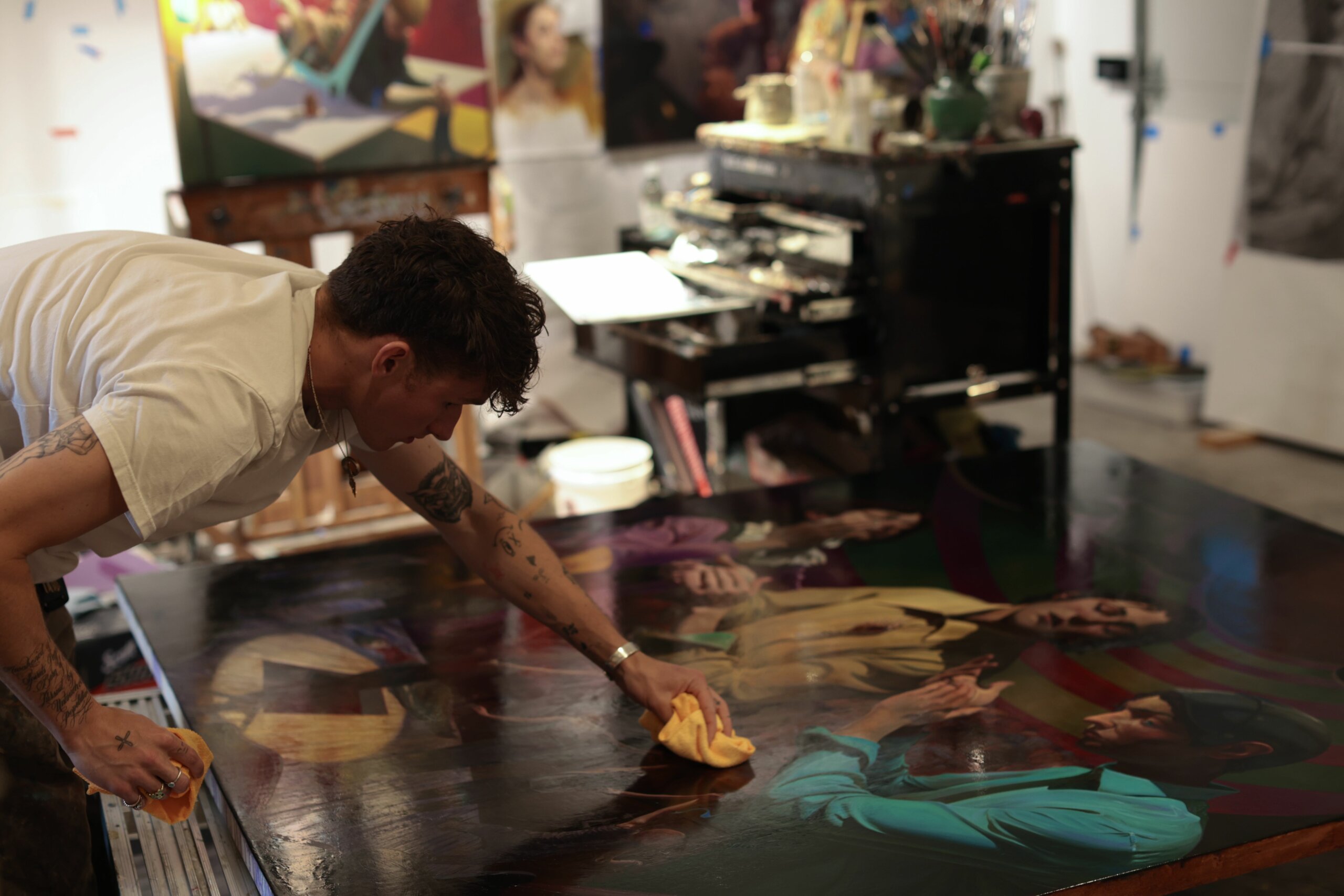
Your practice brings together a deep engagement with the great masters – their draughtsmanship, their technical command – and contemporary subjects, figures suspended between imagination and real life. How do those two forces relate, and what does classical training give you when the image emerges from somewhere beyond conscious control?
My admiration for the great masters is rooted in my love of drawing and the depth of skill required to compose otherworldly imagery through traditional materials and techniques. That obsession developed as I began learning to draw, and it became the foundation that allows me to create these paintings, sculptures, and drawings. The study of the figure, perspective, and composition gives me the tools to capture the scenes that first exist only in my mind. Although the ideas and imagery often develop subconsciously, their form is shaped consciously and with great intention. Once the image moves onto paper, the scene or design enters our shared reality. In that translation, some elements are inevitably lost because they cannot fully transfer from imagination to form. At the same time, much is gained through the act of making decisions, adjustments, and intentions that develop as the work takes shape.
Your work has been described as emerging from the subconscious – sensations and experiences that defy language. Yet, poetry is part of how you work: you write poetry while painting, from the same place of total immersion. How does language enter a process that is fundamentally beyond it? And how does the poem “Yields of Fray” relate to the works it accompanies?
Writing the poems began for me as a practice of introspection after the painting was finished. Over time, I started to think of them as an ambiguous introduction to the work as well. Rather than trying to define or explain the painting, the poems are meant to draw the viewer further into its mystery and narrative – perhaps evoking a feeling or atmosphere that might not otherwise emerge. The poem “Yields of Fray” reflects the journey of escaping reality, or of unraveling the self from imposed structures. It speaks to the process of letting go and moving deeper into the imagination, where joy and a kind of transcendence can be found. In that sense, the poem and the works exist in dialogue as they both emerge from the same immersive state, but language approaches the experience from a different direction than the painting.
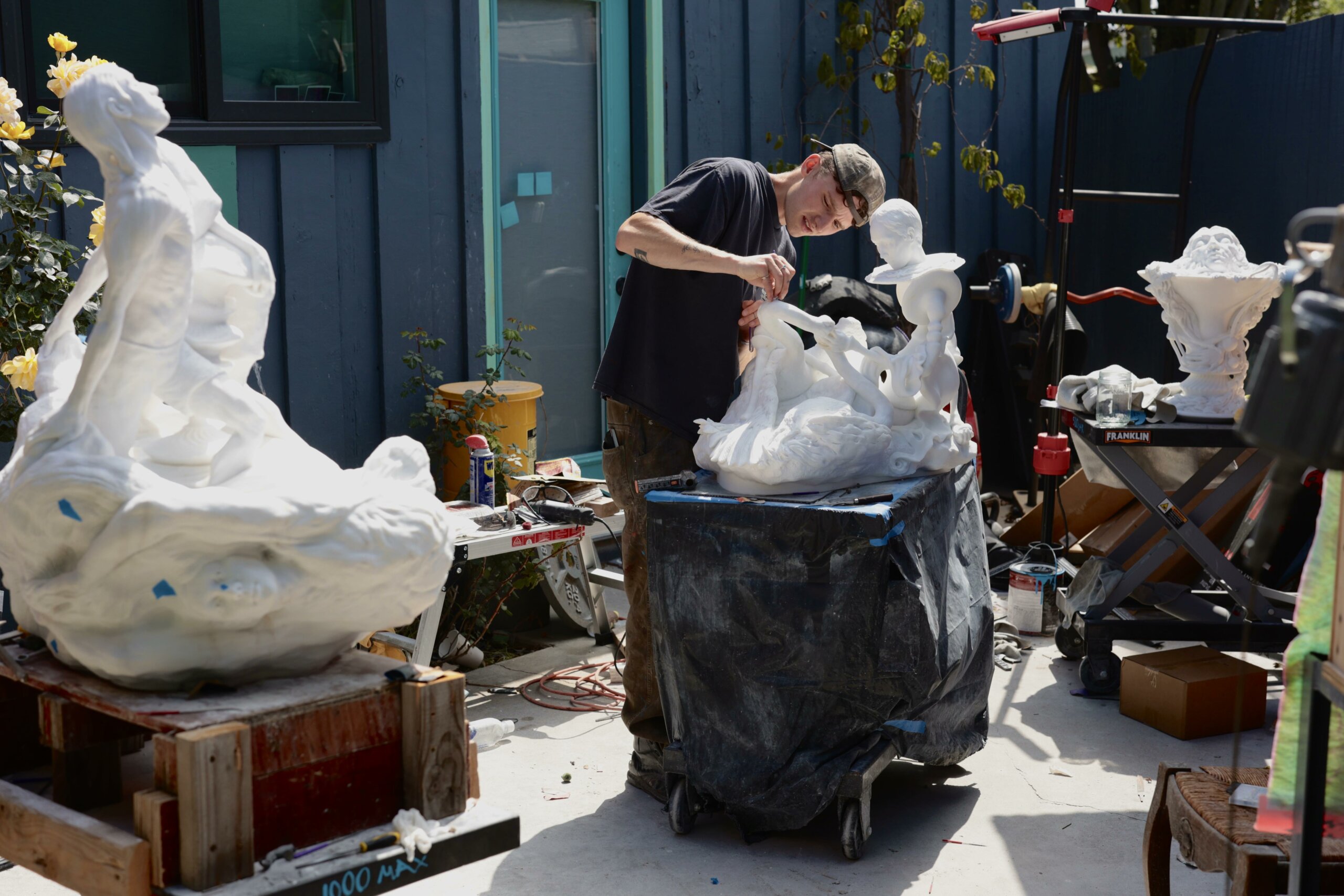
Sculpture is a recent development in your practice, and you describe it as enabling you to “build on” narratives that begin in drawing and painting – a “fluid influence” between two and three-dimensional forms. What happens when a narrative moves from canvas into marble? Does sculpture resolve something the painting leaves open, or does it open new questions?
I feel that the sculptures act as another reading of the scene or narrative, offering a more realised representation of specific elements as they enter our physical world. They also give the viewer a bodily experience of the story, allowing them to literally move around the work and discover different parts of the narrative. Because the paintings and sculptures developed simultaneously, they continually informed one another to the point where neither can be fully understood without the other. In this exhibition, I see the sculptures as markers of time: the same figures or elements from the paintings reappear in a different context, or further along in the unfolding action.
The curatorial text observes that in turbulent times, avenues of escape have themselves become paths to torment – yet fantasy and imagination remain the only reliable forms of respite, and the space where you find inspiration. You were making this work in Los Angeles amid fires, ICE raids, and civic unrest. What do you think about that contradiction between escapism as an impulse and a reality that is impossible to keep out – and do you believe art can genuinely offer refuge?
These are very challenging times. Today we are faced not only with heinous realities on the ground in our cities, but also with constant inflammatory and destabilising media in all its forms. There seems to be a universal sense of angst that is often intensified through endless engagement. I believe it is important to stay informed; however, there is a point at which one must step back, because the cycle can become all-consuming. I often think about how I can be helpful and productive in the world as an individual. For me, that has meant making art and sharing it with others. Even if the influence is small, it is still productive and contributes something meaningful to the whole. I feel that art has always been and will continue to be a place of refuge, healing, processing, protesting, and understanding for both the artist and the viewer. Art made with depth and intention has the potential to reach anyone.
To desire escape, in that sense, is not withdrawal. It is a deliberate act of choosing where to place the mind when the world becomes too loud, and insisting that meaning can still be made there.
This exhibition represents your European debut, and you’re showing in Venice: a city theatrically charged, layered with art history, already existing somewhere between reality and imagination. Does that context feel like a natural home for this work?
I do feel the works fit well here. Over the past year of creating them, I was already inspired by Venice from afar, and my practice overall is strongly influenced by Italian painting. Tiepolo in particular, has always been an artist I’ve admired. The works carry a spirit that is similar to Venice itself, boundless and winding in their narratives, full of light, color, and drama. That resonance feels amplified here, shaped further by the beauty and vibrancy of Venice.
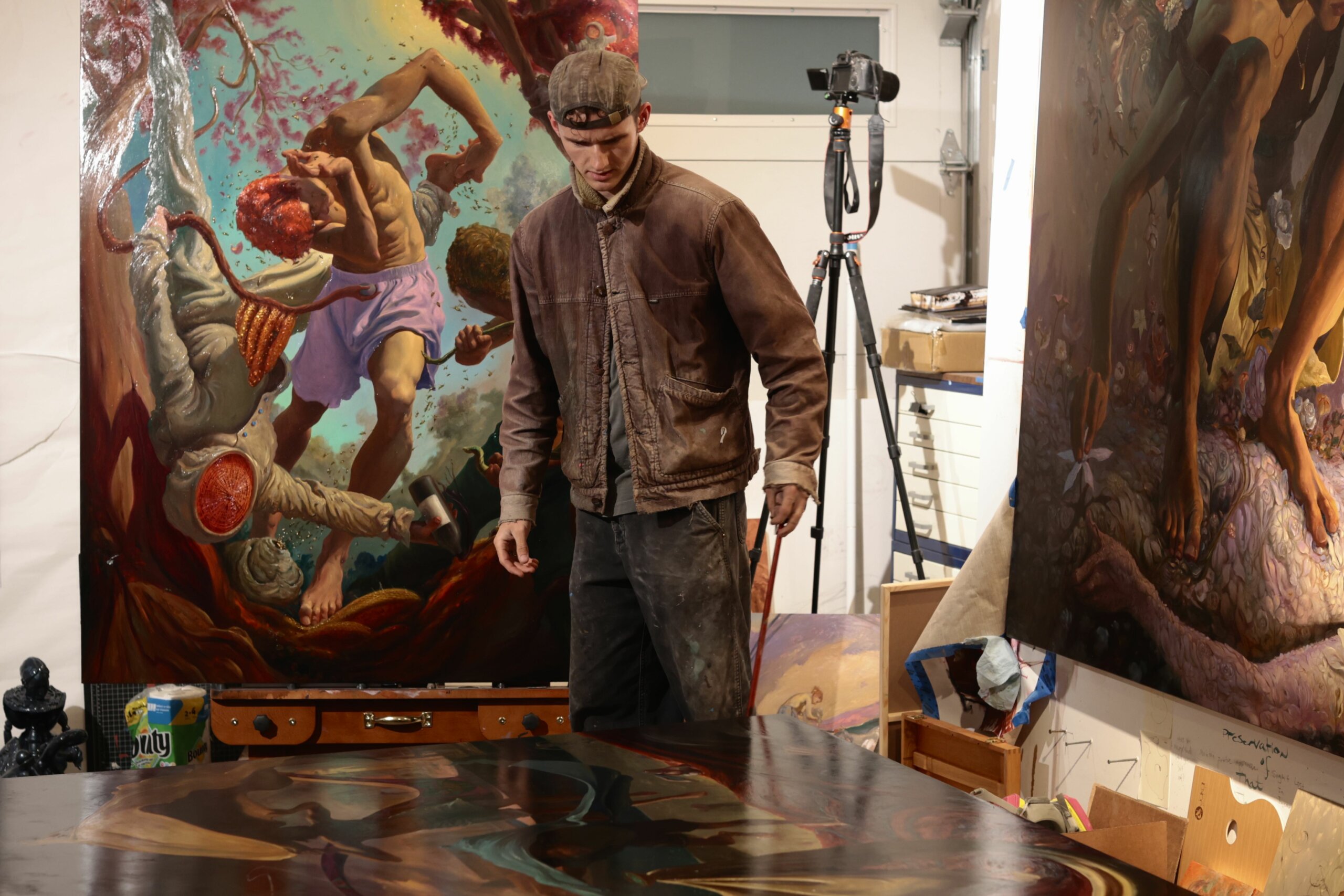
Photo Credits: Avery Norman
Address:
SPARC* Spazio Arte Contemporanea
Campo Santo Stefano, San Marco 2828a
30124 Venezia
Email:
info@privatewaters.art
Website:
privatewaters.art


