

Manuela Kokanović: Tracing the Cartographies of Flow
Manuela Kokanović
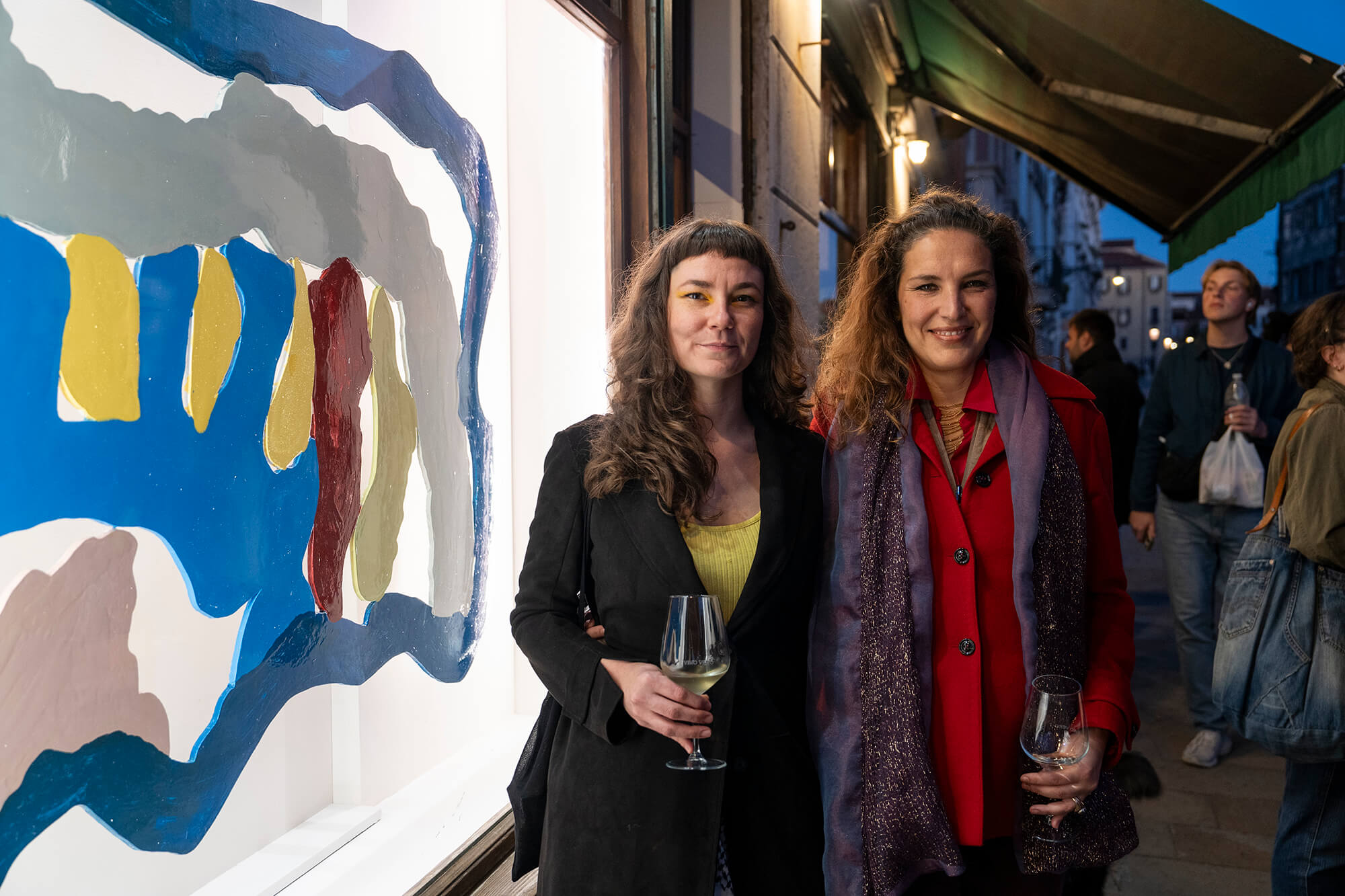
As part of My Art Guides’ ongoing series of dialogues with artists featured in the Vetrina project at Vino Vero Venice, we are pleased to present an interview with Croatian artist Manuela Kokanović. Curated by Mara Sartore, the Vetrina project transforms the display window of Vino Vero into a dynamic platform for contemporary art, inviting women artists to activate the space with site-specific works.
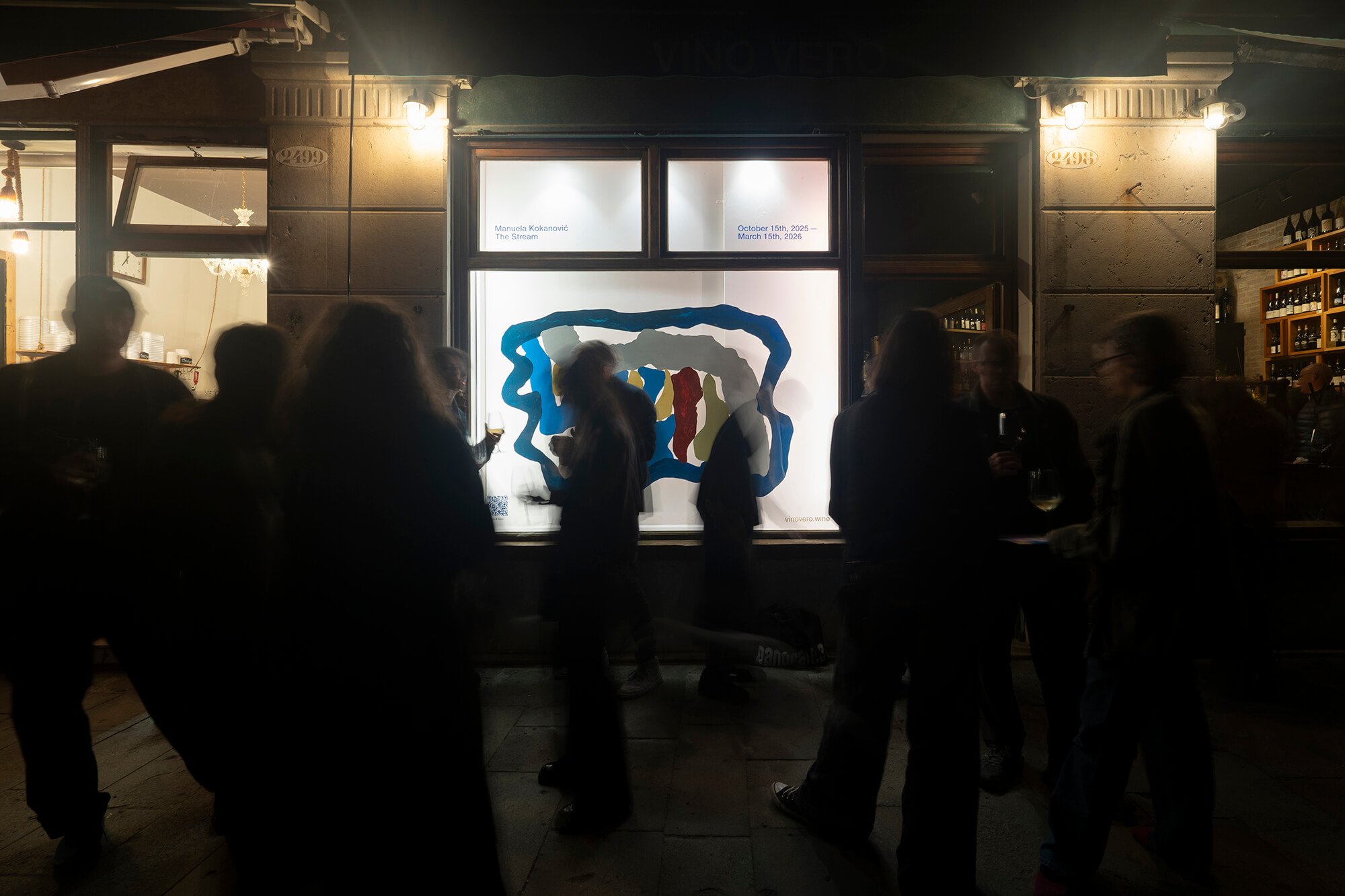
For Vetrina#15, Kokanović presented The Stream, a large-scale installation created on the basis of an interdisciplinary reflection. Bringing together anthropological, geographical, and visual studies, the artist explored the concept of flow as a movement inherent in time and global collective consciousness. In this conversation, we explore with the artist the origins of The Stream, her dialogue with matter and form, and her ongoing reflection on mapping, flow, and transcultural identity.
Mara Sartore – In your work, matter has always played a central role, made of layers, sedimentations, and dense or fluid surfaces. Painting is often described as your “concrete ground,” yet over time your research has also opened up to installations, sculptures, and edible elements such as isomalt. How do these different practices interact within your work today?
Manuela Kokanović – A mass of colour always has a certain freedom in its movement across the surface and in the way it solidifies as it dries. The construction of forms puts thought and intention in dialogue with the possibilities and limitations of the tool, whether it is a brush or a spoon. Pictorial fields may resemble edible creams, sugar surfaces may appear like glass: it is a game that makes the perception of reality ambiguous. With this I want to suggest that – in my painting and in my cooking – the transcultural influences that run through me mix, seep in, and blend together.
MS – The Stream originates from a reflection on flow as a movement that crosses time, space, and collective consciousness. How did you arrive at this image and what does the idea of “flow” represent for you today?
MK – Friedrich Strass illustrates universal history by depicting each nation as a watercourse that may either be interrupted or flow undisturbed depending on territorial conquests or the preservation of peace. My perception of contemporaneity is the perception of perpetual movement, of a flow that disperses into the rivulets of infinite interpretations. In my work I seek to convey this perception, this flow freed from the constraints of objective representation, channeling it into that particular configuration which is my artistic practice.
MS – In The Stream you use the map as a visual and conceptual device, drawing inspiration from ancient cartographies that predate an “objective” geography. What interests you about these archaic maps, and why do they still seem such powerful tools for reflection today?
MK – These maps are instruments of knowledge and remind us that our vision of the world is not objective, but shaped by our geographical position, our historical moment, and our cultural or religious belonging, among other factors. By observing them we may find inverted cardinal directions, enveloping seas, perfectly circular landmasses, or symbolically enlarged territories. They remind us that it is our experience that determines our vision of the world.

MS – The Stream is a site-specific installation and, at the same time, a kind of mapping of the creative process itself, understood as a privileged and “dimensionless” flow. How do you experience the relationship between the artwork, the process, and the exhibition space in this project?
MK – Whenever the exhibition space or the theme of a show diverge from what usually guides my practice, I find myself imagining new solutions, and my research opens up to unexpected directions, marking turning points in my path. Faced with the particular dimensions and placement of the Vetrina, I chose to experiment with a different approach, in which painting becomes installation and the installation, in turn, returns to painting. The forms presented are not only fragments of an imaginary map, but also brushstrokes that have transformed into self-supporting elements, emancipated from the background surface and capable of existing autonomously in space.
MS – In your statement you speak about cultures and places that are “only apparently distant.” How much have your travels, residencies, and living between different contexts influenced the construction of your visual imagination?
MK – Every language I speak activates a different part of me: each represents different moments of my life; different ages, different fields, different skills. Sometimes I have the sensation of moving through multiple identities, as if each language preserved a specific emotional and cultural memory. Similarly, the language of art changes according to the possibilities, influences, and forms of exchange that a context offers. Cultures and places that might appear distant from one another actually draw closer and overlap in my work: they become layers of the same inner geography, where linguistic and cultural differences do not exclude each other but rather contaminate and enrich one another.
MS – You are part of several collective projects and artist-run spaces, from Fondazione Malutta to Venice Time Case. In what way has collaborative and curatorial work influenced how you think about the artwork and your role as an artist?
MK – In Venice I encountered a context where collective growth is both a method of study and exchange, as well as a way of living everyday life. Over the years I have come to understand how this attitude represents a form of resilience within the local community, which through independent spaces and shared projects has affirmed a model based on cooperative rather than competitive thinking. Thanks to this environment I have had the opportunity to participate in the development of numerous collective projects, which have led me to see my work as part of a whole that is completed and gains importance through the work of others – and that, in turn, must offer others a clear, strong, and sincere vision, free from self-referentiality. Every artwork is part of a dialogue that transcends the individual; being part of collective projects has taught me the importance of this dialogue and of every voice that participates in it.
MS – Looking at your broader trajectory, what are the themes, images, or questions that you feel you will carry with you into future works? And what are you currently working on, or imagining developing in the near future?
MK – Some images have accompanied me for years: they resurface, transform, change their weight and temperature. They are like underground currents that periodically re-emerge, asking to be reread in the light of new awareness. If earlier I inhabited certain questions in an instinctive way, today I feel I can move through them with greater clarity. My aim is always to remain faithful to the questions that have guided my research, but also to take a new, perhaps unexpected step, capable of being both an answer and a new question. I certainly intend to continue my reflection on the theme of maps and their role within the process of defining individual and collective identities, and to open myself to the possibility of new dialogues and collaborations.


