

Marilisa Cosello, “Siren”: Body, Labour and Power
As part of My Art Guides’ ongoing series of dialogues with artists featured in the Vetrina project at Vino Vero Venice, we are pleased to present an interview with artist Marilisa Cosello. Curated by Mara Sartore, the Vetrina project transforms the display window of Vino Vero into a dynamic platform for contemporary art, inviting women artists to activate the space with site-specific works.
For Vetrina#17, Cosello presented “Siren”, a site-specific installation that takes labour as a political field to intercept the imaginary of the “Office Siren” – the contemporary reactivation of 1990s corporate aesthetics as an object of desire – and to interrogate the condition of the female body as an instrumental function within the productive machine.
Marilisa Cosello
MS – After studying Film History, you trained in photography, working for several years as a photojournalist before turning toward an artistic and conceptual practice. Was there a specific moment when documenting reality no longer felt sufficient to you, and you began instead to question how reality itself is constructed?
MC – I had already encountered the illusion of the real while studying cinema, where a frame is a decision and meaning arises from editing, from the relationship between one image and the one that follows. Then came photography, and news photography specifically, which lives on a promise: that no gap exists between the fact and its image. But the gap is precisely what happens – the chosen instant, the distance, what is left out, the caption that comes afterward. I realised that bodies already knew their own part to play, that institutions produced their own image in advance and under control: reality was already constructed.
Later, in my artistic practice, approaching the construction of an image speculatively allowed me to work on what a single fact fails to show. Power, discipline and expectation have precise forms, and translating them into a constructed scene, where pose and repetition remain visible, is how I observe them and make them legible.
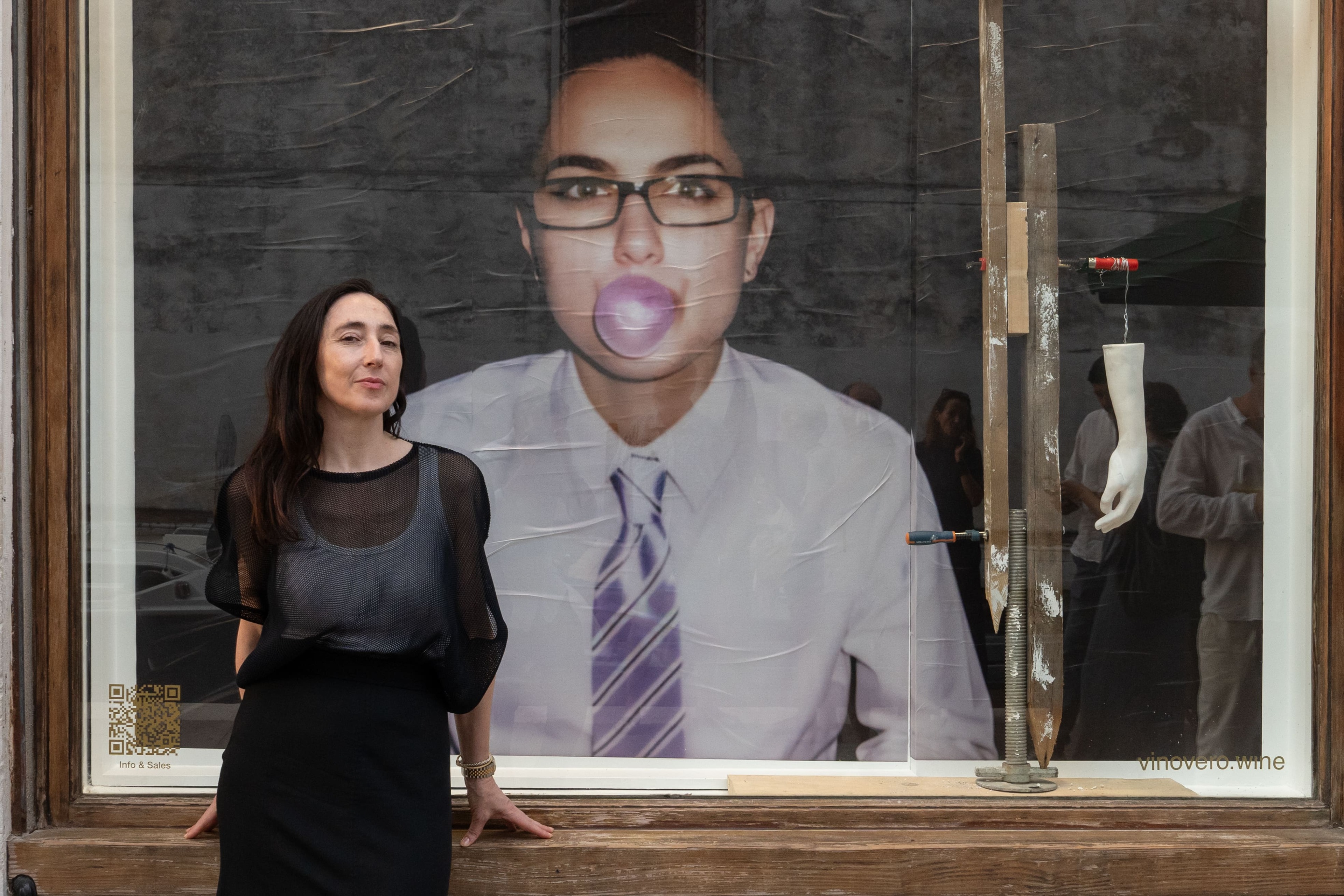
MS – The body has become progressively central to your work: a disciplined body, trained, socially coded, embedded within systems of power and expectation. What initially led you to consider the body as a political space? And how has your way of working with it changed over time?
MC – A body that trains agrees to be read. Every discipline works by measuring: how fast you are, how much you can endure, how closely you match the form assigned to you. Power is exercised in the choice of the unit of measurement, long before any visible imposition. The twentieth century made the body its own medium: mass gymnastics, parades, thousands of people performing the same movement at the same instant. A trained body communicates what a discourse would have to argue, and it does so by presenting itself as nature: health, order, beauty. I think of Fabio Mauri's "Ideologia e Natura" (1973). I began to consider the body a political space by recognizing those same choreographies in productive efficiency, in performance, in self-care. Behind every image of strength there is an apparatus: years of training, a technique, repetition, an accepted fatigue. At first I represented this condition, then I began to construct the situations in which it is produced – we might say the settings in which the body moves: an assigned exercise, a duration, a repetition without result. I remove the podium, the field, the event, and what remains is the gesture with its own discipline. At that point the body stops being the subject of the image, and what becomes visible is the apparatus.
MS – The female body occupies a particularly complex position in your research: it acts, competes, works, desires, but is also continually observed, measured and subjected to models and expectations. In the gestures you stage, there often seems to be an ambiguity: what appears as an expression of strength, freedom or emancipation can simultaneously reveal the system that disciplines it. Is it this tension that you're looking for?
MC – The female body is observed before it becomes a subject. It doesn't become political when it acts, it already is political in the way it is allowed to present itself: a learned form, a bearing, a measure dictated by others. Twentieth-century feminist thought described this extensively: the woman who appears while the man acts, the gesture trained to contain itself, the feminine as something one becomes. It still holds true, with one difference: today that "form" is tied to the concept of desire. In my practice I observe this Body from the outside: I work with athletes and performers, I assign an exercise, I set a duration, I remain on the side of the one who watches. Every image of female power carries with it an apparatus that isn't visible: the technique, the discipline, the threshold of fatigue that is accepted. I'm interested in who set that threshold, and who decides which bodies get to be on stage. Competition, ambition and performance are real freedoms and real obediences – they happen in the same gesture, and neither cancels the other out.
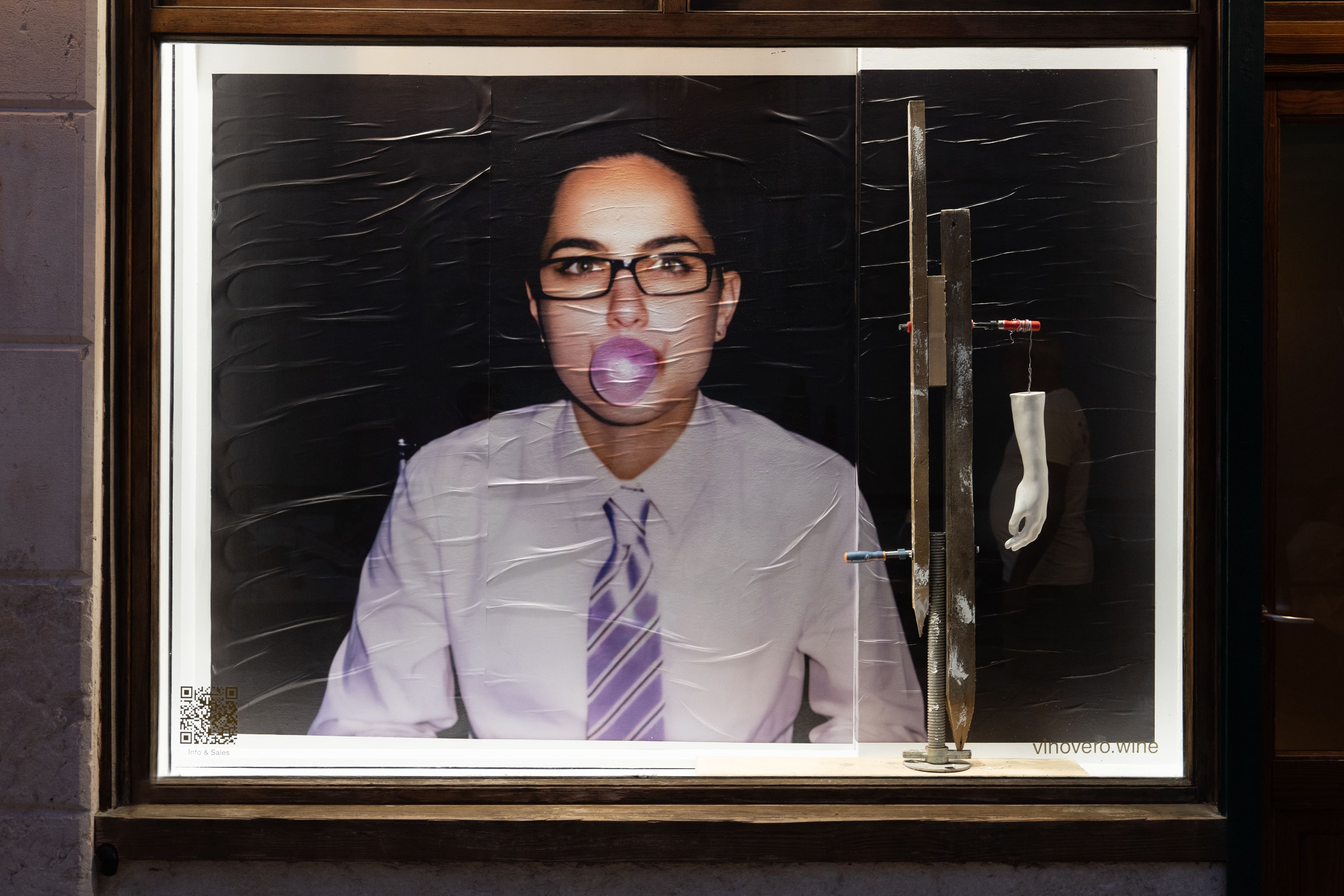
MS – With "Siren", your attention shifts to labor and to the contemporary resurgence of 1990s corporate aesthetics through the figure of the Office Siren. What interested you about this phenomenon? And what does the return of this seemingly emancipated image of femininity tell us, in your view, about the relationship between desire, work and power today?
MC – "Siren" starts from labour as a political field. I'm interested in the Office Siren as a contemporary reactivation of 1990s corporate aesthetics turned into an object of desire, and as an occasion to interrogate the condition of the female body as an instrumental function within the productive machine. The framework is Mark Fisher's capitalist realism, and his account of the slow cancellation of the future. Fisher describes a present saturated with the codes of work, where even desire, seduction and subjectivity are recalibrated according to the logics of productivity. The cyclical return of past aesthetics is the declaration of a future that can no longer articulate itself: the slow erasure of a collective imagination that discovers itself already colonised. The return of this seemingly emancipated image says exactly this. "Siren" brings the female figure back to the threshold where body and apparatus coincide, and there the aesthetics of labour reveals itself as the very form in which desire presents itself today – the ambiguity you were describing.
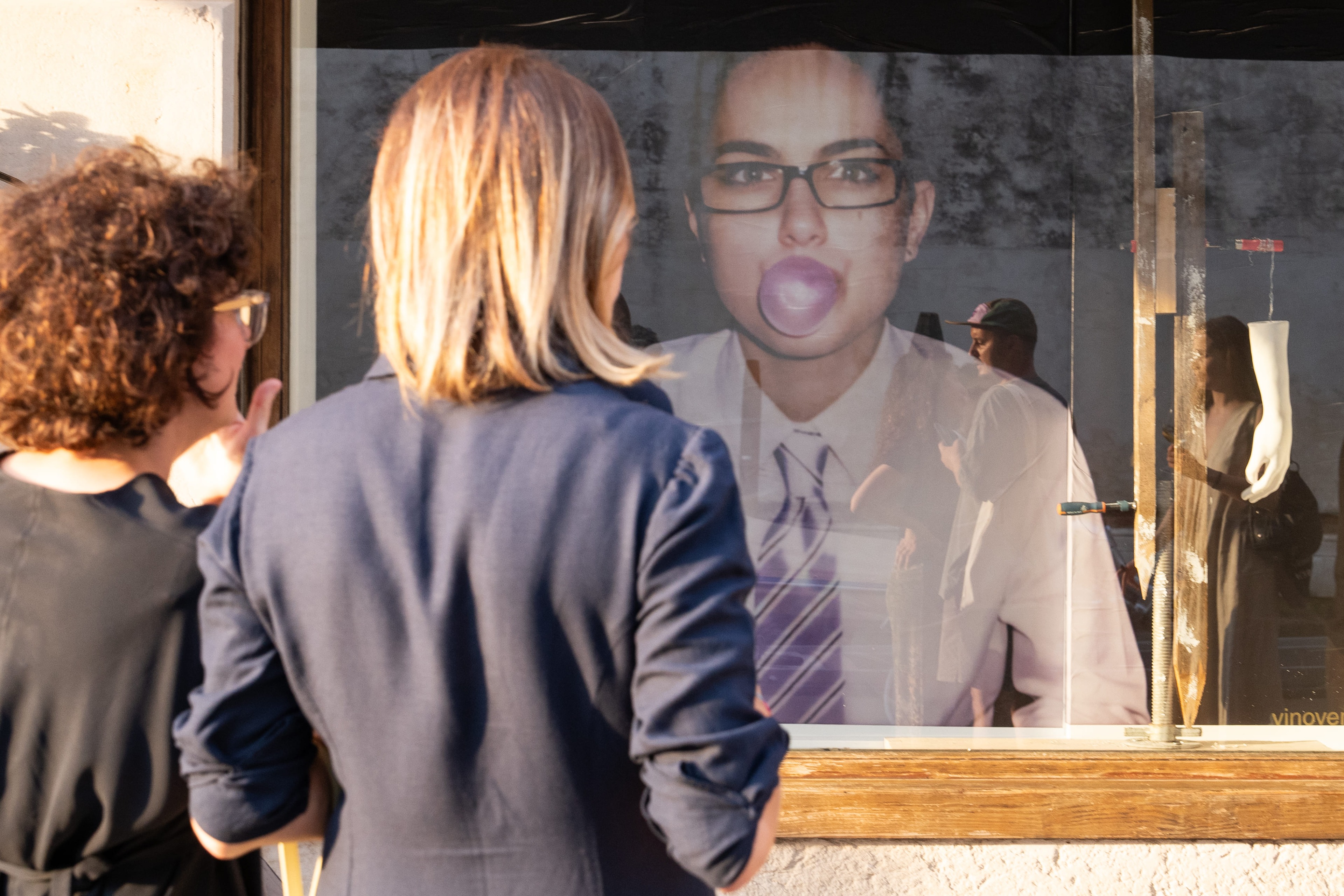
MS – "Siren" was conceived specifically for Vetrina at Vino Vero, a space that is neither a gallery nor a neutral exhibition environment: the work lives behind glass, directly on the street and within the everyday life of a place frequented by a public that doesn't necessarily come to see art. How did this particular condition influence the conception of the work? And now that "Siren" inhabits this space, what is this experience giving back to you?
MC – The shop window is an exhibition format with a long history: long before the white cube became the norm, works stood behind glass, on the street, within the traffic of the city. At Vetrina, the work doesn't sit inside a room – it's an opening onto the street. It's looked at from outside, in passing, at any hour, and it becomes part of the urban landscape. Conceiving it for this space meant thinking of it as an image that is read in the time of a passing glance, and that also withstands a repeated one. The Vetrina gives you back the limits, the dimensions, the depth, which here immediately become decisions, and the fact that it is a continuous exhibition in the present tense: the light changes, the street changes, who passes by changes, and every day the work is slightly different.
MS – "Siren" will culminate on September 9 with a performance, introducing the body and action into the installation. What dimension of the work do you want to bring out through this performative moment? And what kind of reaction, reflection or experience would you like to elicit in the audience?
MC – The installation works on the image; the performance introduces real time and voice: the figure leaves the shop window and moves into the water. I'm interested in the double meaning of the word "Siren". There is the creature that sings to attract, and there is the siren that marks the beginning and end of a shift. The performance holds both meanings together: seduction and the call to work. The action proceeds back and forth, without arriving anywhere. Whoever is watching won't immediately know whether what they're seeing is an artwork, a promotion or an actual event – and that uncertainty is part of the work.
