

Nalini Malani: Of Woman Born – Memory, Myth, and the Urgency of Women’s Voices
Through layered animations and immersive environments, Malani meditates on patriarchal violence, geopolitical accountability, and the suppressed agency of women, proposing empathy, interconnectedness, and the retelling of stories as necessary tools to imagine a more humane future.
Nalini Malani
The title “Of Woman Born” is described as a ‘thought chamber’ on women, myth, and global conflict. What does “Of Woman Born” mean to you as a title, what does it carry?
It is the common thread of humanity that connects us all, from any religion, culture or man-made border. Acknowledging this universal connection would give us a different understanding of life and therefore a different approach on how to solve conflicts. It would not be through violence but through empathy and compassion.
The work is inspired by the Greek myth of Orestes. You have built a practice rooted in cross-cultural and historical dialogue – what drew you specifically to this myth, and more broadly, what does it mean for you, as an Indian artist, to work with a myth from the Western tradition?
The complexity and multi-dimensional interconnections, especially in the 21st-century world, need an art language which crosses cultures. The connections between Western tradition and India are not new, as my friend Thomas McEvilly eloquently proved in his book “The Shape of Ancient Thought”. What is new in my artwork – and that is also why I was inspired by the Greek myth of Orestes – is that I propose a different position for women in our society. The judgement of Orestes by Athena did not bring real progress in the development of the law, and women are not seen as equal in importance for mankind.
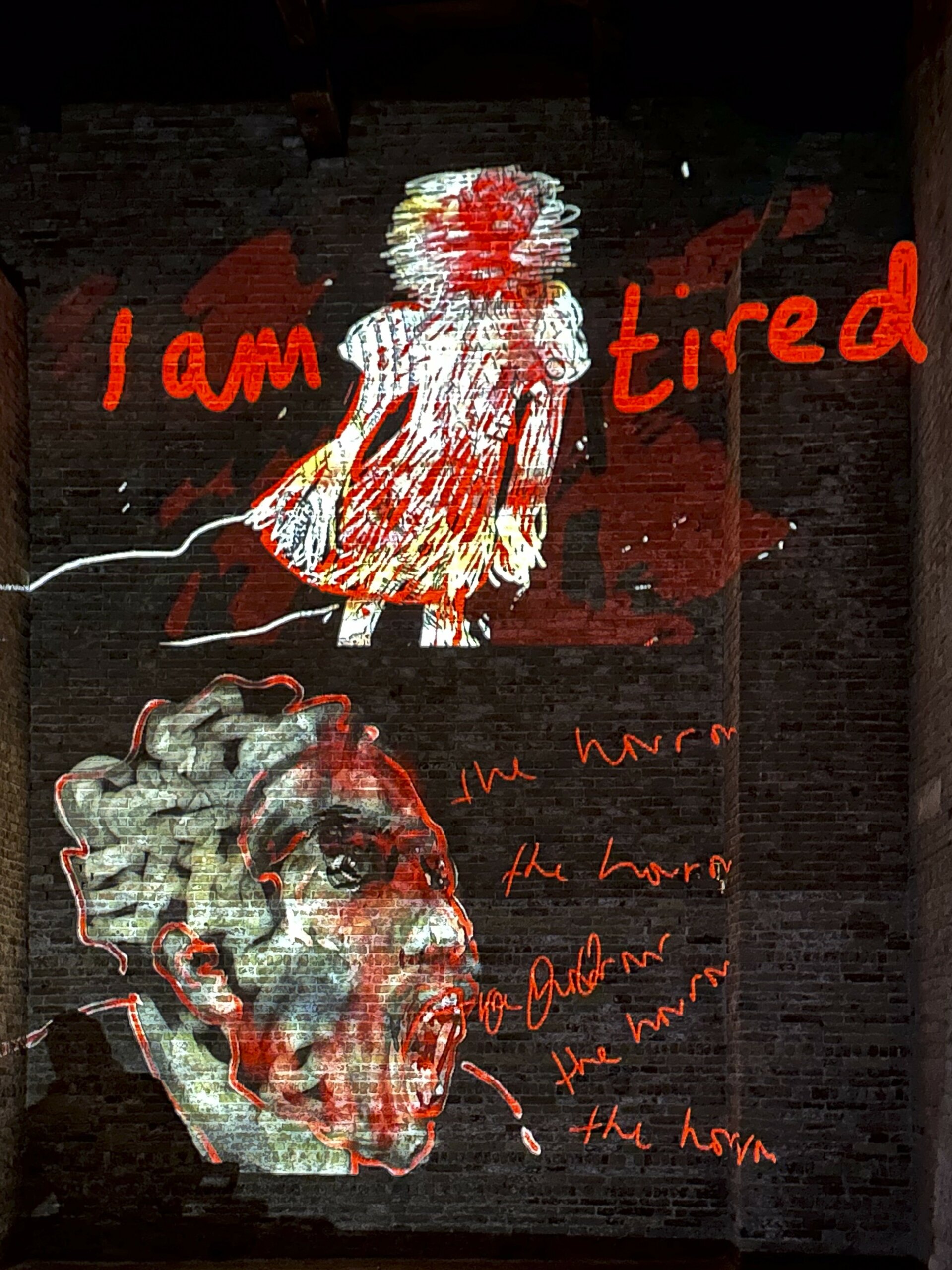
Nalini Malani, “Of Woman Born”, 2026. 9-channel iPad Animation Chamber, sound, dimensions variable. Collection – Kiran Nadar Museum of Art © Nalini Malani
You describe the contemporary geopolitical experience of the world as something that makes you want to “clench your fists, grit your teeth, to shout out”. How does rage – and in particular the rage of women, bearing the brunt of global conflict – function in your work? Is it a subject, a fuel, or both?
It is both, and much more. So many thousands of years have been wasted, where more than 50% of humanity was constitutionally suppressed, due to the patriarchal state. What once was a dream of Modernism with equality for each has turned, in the 21st century, into a world battle between male dictators.
This large-scale installation extends your pioneering “Animation Chamber” series, which you have been developing since 2017. It presents images that appear and disappear, never settling, including 67 animations with over 30,000 drawings made on an iPad, projected across nine video channels. How do you think about the relationship between the hand, the machine, and memory in this work?
Memory itself, for me, is a medium, with which I work as an art tool, to come to an understanding of one’s position in the present, past, and future. Memory hence is the key component of my works since the late Nineties, when the tide of orthodoxy started to threaten our communities.
In a fleeting world, nothing is sure of its future. At best, you become the custodian. To work with my fingers on the iPad, and not the iPad pencil, gives me the opportunity to mess around, like how it works in my mind. A stream of collisions of visual and textual memories, with no predesigned roadmap.
Nalini Malani, “Of Woman Born”, 2026. 9-channel iPad Animation Chamber, sound, dimensions variable. Collection – Kiran Nadar Museum of Art © Nalini Malani
The work will be presented at Magazzini del Sale – a historic venue for contemporary art in Venice – where the projections will fall directly onto the salt-crusted brick walls. How does the building’s material history become part of the work’s meaning?
These aged bricks soak in the colours of the video projections. It is as if the images are pure powder pigment wall drawings. Various experts advised me not to project directly on the bricks, but when I came here for the first time, and licked the salt from my finger, I felt that this is a materialisation of history you can’t deny, but should embrace.
I had made earlier video projections on salt as in my video play Hamletmachine in 2000. The Salt March led by Mahatma Gandhi in 1930 was a pivotal act of civil disobedience against British rule in India. Similarly in our current international state of the world we need a nonviolent, life-and-death struggle against ongoing injustice.
Public activations for the exhibition during its duration in Venice will center on a recurring feature in your artistic language, “The Skipping Girl”. What is her role and what does she embody?
“The Skipping Girl” has appeared in many of my artworks, from a zoetrope in a theatre play in 1997 to an animation for the website of dOCUMENTA(13) in 2012. She is, for me, a figure of innocence, freedom and hope – a most precious state of mind which we should treasure, and which we need especially in these dark times.
After sixty years of politically engaged practice, you describe the need to retell stories as more pressing than ever. What has changed in the world – and what hasn’t?
The progress of technology has changed the world drastically. Unfortunately, the progress of mankind hasn’t.


