

Stefano Cagol: We Are All Nauru
Stefano Cagol
“Venice Biennale Portraits” is a series of interviews conceived and conducted by Mara Sartore, featuring some of the most significant figures in the contemporary art world on the occasion of the 61st International Art Exhibition – La Biennale di Venezia. Collectors, curators, artists, and directors engage in conversations exploring their roles, upcoming projects, and their relationship with Venice.
On the occasion of the Republic of Nauru’s first-ever participation in the 61st International Art Exhibition – La Biennale di Venezia with the pavilion “AIM Inundated: Imagining Life After Land”, Mara Sartore spoke with Stefano Cagol, participating artist and Associate Curator. Their conversation explores the conception of his new works, the environmental and geopolitical narratives underpinning the project, and how art can offer new perspectives on humanity’s place within the vast temporal and material processes of the Earth.
MS – You are one of the few Italian artists taking part in this year’s Venice Biennale through the Pavilion of the Republic of Nauru. How did this project come about, and how did you end up representing such a distinctive country within the context of the Biennale?
SC – The Republic of Nauru, the world’s smallest island state, is making its debut at the 61st International Art Exhibition of the Venice Biennale, whereas for me this is not a first. In fact, my participation is closely connected to an earlier experience.
I took part in a national pavilion in 2013, when the Maldives made their own debut in Venice. I was invited by Alfredo Cramerotti and Khaled Ramadan of the curatorial collective Chamber of Public Secrets (CPS), following their work as curators of Manifesta 8. Their Maldives National Pavilion was among the first examples of a small island nation using the Biennale as a platform to reflect on issues extending beyond national identity, such as sea-level rise and vulnerability within global geopolitical systems. On that occasion, I presented The Ice Monolith, a work exploring the relationship between ice, human impact and environmental responsibility.
Over the following years, Khaled Ramadan continued to develop these themes, which ultimately led to his appointment as curator of Nauru’s first-ever pavilion. Within this context, he invited me once again, both as an artist and as Associate Curator (alongside Camilla Boemio), recognising my longstanding research into the relationship between the Anthropocene, the environment, energy and deep time.
One of the new works I have presented continues this dialogue with my previous participation. The “Ice Monolith – After Land” is a critical re-edition, approved by the Biennale for Venice’s public spaces. Installed in the very same location on Riva Ca’ di Dio, a comparable block of Alpine ice was left to melt under the sun, just as it had been in May 2013.
The notion of disappearance has become even more powerful in relation to the island of Nauru and its history of intensive resource extraction for mass society. The work is no longer solely about rising sea levels, but also about the depletion of land, culture and future. For this reason, I introduced a performative element, carried out before a live audience and documented. On the afternoon of the first day of melting, I repeatedly struck the monolith with a heavy sledgehammer. Human impact was deliberately intensified.
In both instances, small island nations, often regarded as peripheral, become privileged sites from which to reflect on the major transformations shaping our planet.
MS – The works you are presenting in the pavilion – “We Are All Nauru” and “Ex Ore Ignis” – address environmental, geopolitical and existential themes. Could you tell us how they came about and what kind of reflection you hope they will inspire in the audience?
SC – These works emerged from a direct experience of the environment, which for me is never a mere backdrop but the true interlocutor. In most of my projects, I work entirely on my own, using a drone as an extension of both my gaze and my body, simultaneously acting as performer, director and camera operator. This enables an intimate and, in some respects, spiritual relationship with the places I encounter.
I am interested in understanding the relationship between human beings and Earth’s systems, and in exploring how landscapes retain the memory of our actions. Ice, fire, wind and heat become elemental forces through which to reflect upon the profound transformations of the planet.
Within the pavilion, “We Are All Nauru” is a two-channel video installation—a diptych filmed partly in Houston, Texas, the cradle of the oil industry, and partly in Greenland, a territory now increasingly contested for its natural resources. The work reflects upon the interconnection between geological processes, the voracity of mass society and contemporary geopolitical tensions.
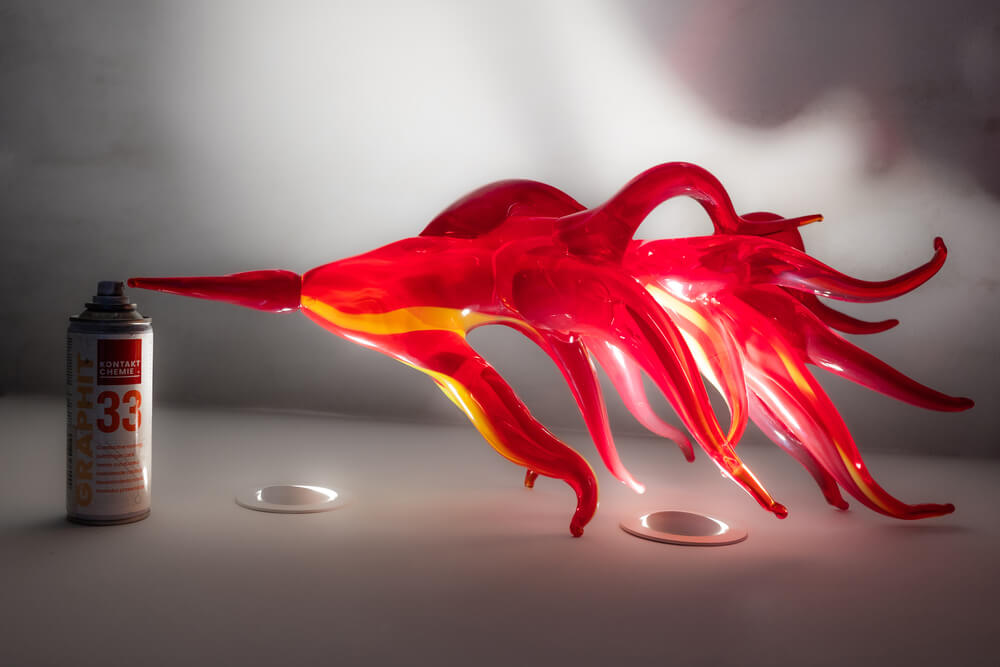
In the sculptural installation “Ex Ore Ignis”, the flame ignited in the Arctic in the video—using an aerosol spray as an attempt to exorcise the consequences of our everyday actions—is fossilised through Murano blown glass. An ephemeral gesture is transformed into a permanent presence, making visible the enduring consequences of our impact. The work is also included in “Glasstress 2026” at Palazzo Ca’ Tron.
The development of these works was profoundly shaped by direct and personal exchanges with scholars such as the geologist Minik Rosing, whose research into the origins of the Earth fundamentally reshaped our understanding of the earliest evidence of life. Equally important was my dialogue with Timothy Morton. His concept of the “hyperobject” helped clarify a question that has accompanied my practice for many years: how can we make perceptible phenomena that are so vast and variable that they escape direct human perception?
The resulting works do not seek to impose answers; rather, they invite viewers to experience a different awareness of their own place within the history of the Earth.
MS – The title of the pavilion, “AIM Inundated: Imagining Life After Land”, evokes a scenario that is both extreme and increasingly conceivable. What does imagining “life after land” mean to you, and how does this idea relate to your artistic practice?
SC – Imagining Life After Land is not intended as an apocalyptic vision. Rather, it is an invitation to adopt a different perspective.
Land is not merely the physical ground beneath our feet. It also represents stability, belonging, permanence and even identity. To imagine life “after land” is therefore to ask what happens when these certainties begin to dissolve, and to recognise that the planet is not a static backdrop but a dynamic organism.
This perspective runs throughout my practice. Working in Greenland, the Arctic, mining deserts and landscapes shaped by energy production has brought me into contact with places where human time seems to lose its centrality. Walking across the Arctic ice sheet, engaging with icebergs, observing some of the oldest rock formations on Earth or crossing landscapes transformed by extraction means confronting deep time—a history of the planet that predates our species by billions of years. Such an awareness inevitably reshapes our understanding of humanity’s place within it.
For this reason, the human body in my work never dominates the environment. Instead, it enters into dialogue with forces that exceed it. Human beings are measured against elemental energies and geological processes that will continue long after our existence.
I believe that this shift in perspective is one of the most urgent challenges of our time: learning to see ourselves not as the measure of all things, but as a temporary presence within an infinitely larger history.
MS – A project like this engages with scientific, environmental and political issues, while also involving dialogue with a small island nation such as Nauru. What were the greatest challenges, both in terms of production and from a conceptual point of view?
SC – The greatest challenge was preserving complexity while making it visible through reflections that are both profound and immediate, without diminishing their meaning.
Today, we are accustomed to interpreting reality through separate categories: politics on one side, the environment on another, followed by economics, science and culture. We are equally accustomed to pitying others or assigning blame elsewhere. More generally, we tend to keep our distance.
Distancing ourselves may be comfortable, but it is no longer possible.
Consequently, another challenge was to approach Nauru not as a distant, isolated reality, but as a global metaphor. The extreme extractivism embodied by the island of Nauru concerns far more than the exploitation of its phosphate deposits. It represents the cultural paradigm that has shaped modernity itself: the belief that the Earth is an inexhaustible reservoir of matter and energy, available for unlimited human use. Nauru’s phosphate mines, the vast oil fields and Greenland’s rare earth deposits all tell the same story: a relationship with the material world founded upon voracity and consumerism.
For this reason, I chose the plural subject for the title of my main work, “We Are All Nauru”, which itself echoes the title of an earlier project, “We Are the Flood”, developed as an evolving platform in collaboration with MUSE – Museo delle Scienze di Trento.
Perhaps this is the most important objective we should pursue: fostering a relationship based on sharing and coexistence, while recognising our common belonging within the Earth’s ongoing processes.
Credits:
Mara Sartore & Stefano Cagol @ Stefano Cagol, The Ice Monolith, After Land, 2026, Riva Ca’ di Dio, Venezia. National Pavilion of the Republic of Nauru at the 61st International Art Exhibition – La Biennale di Venezia. Photo: Giulia Broz.
Stefano Cagol, We Are All Nauru, 2026, two-channel video installation, 10 min / loop. National Pavilion of the Republic of Nauru at the 61st International Art Exhibition, La Biennale di Venezia. Photo: Sofia Brogi-Say Who.
Stefano Cagol, We Are All Nauru, 2026, two-channel video installation, 10 min / loop. National Pavilion of the Republic of Nauru at the 61st International Art Exhibition, La Biennale di Venezia. Photo: Giulia Broz.
Stefano Cagol, Ex Ore Ignis (From the Mouth of Fire), 2026, sculpture, hand-blown Murano glass, 40 × 25 × 20 cm. Realized in collaboration with Berengo Studio. National Pavilion of the Republic of Nauru at the 61st International Art Exhibition, La Biennale di Venezia. Photo: Sofia Brogi-Say Who.


