

Inside the .ART Award: Ulvi Kasimov on Documentation, Digital Identity and Artistic Legacy
To mark the launch of the .ART Award, .ART founder Ulvi Kasimov shares his thoughts on the evolving role of documentation, digital identity, and artistic legacy. From the value of context to the importance of owning one's digital presence, he reflects on how artists can shape their practice in an increasingly digital world.
Ulvi Kasimov
What inspired .ART to launch The .ART Award, and why did you feel this was the right moment to create a global award focused on documentation and digital presence?
UK – The .ART Award is the anniversary marker of a decade of building the .ART registry. When we launched the .ART domain in 2016, we set out to build the digital infrastructure the art world had never been given. Ten years later, more than 315,000 artists, galleries, museums, and cultural institutions call a .ART domain home. That is a serious community, and an anniversary is the right moment to give back.
This is not my first award, though it is the first of its kind. For the past ten years we have been part of Investor Allstars, a technology and venture awards convened by GP Bullhound, where we have sponsored the Digital Innovation in Arts and Culture category. Throughout that decade, we sat inside a venture and technology community, and the award celebrated where creative practice was meeting capital and innovation. Over these years, .ART has grown into an entirely different ecosystem, built around artists, galleries, museums, and the institutions that support them. The .ART Award marks that transit. What began as a category we sponsored inside a tech community is now being launched from inside the art community itself.
There is a second reason for the timing. Over these ten years I have watched the art world reach a threshold. Increasingly, what a curator, a collector, or an institution encounters first is not the artwork itself but the digital trail around it. The archive, the process, the artist’s own voice. The .ART Award is a way of acknowledging that shift, and of encouraging artists to take ownership of that trail.
Many art prizes focus primarily on the finished artwork. The .ART Award places emphasis on the creative process, documentation, and the artist’s archive. Why is this distinction important to you?
UK – The process of creating the work and its context are what create the value of the work, including the way the artist themselves evaluates it. The main prize is not money, but the act of an artist organizing and articulating their own context. In that sense, every participant will receive the main prize.
This proposition has deep roots. You can trace it back through the entire arc of modern and contemporary art. Duchamp signed a urinal and made it art in 1917, and one could argue the shift begins earlier still. A century later, Cattelan taped a banana to a wall and it sold for six figures. In every case, the physical object is almost incidental. The meaning is in the framing. The value lives in the context.
What is different now is scale and urgency. The culture of context, its assembly, its curation, its documentation, has become the most active site in art. We believe this trend will only accelerate across the coming decades, particularly because of AI. When anyone can generate an image in seconds, the context of that image’s creation becomes the entire argument. The picture is only the beginning. The rest is the practice, the intention, and the archive around it. Together, they are the reason I am the artist rather than the tool.
Most prizes reward the object that survives. That model still works for finished paintings, but it leaves out much of what makes contemporary practice interesting: the process, the iteration, the reflection. When an artist prepares a submission for The .ART Award, they build an archive that will keep giving them value long after our jury has finished reading. That work stays with them.
How do you see documentation changing the way artists communicate their work? Can documentation become part of the artwork itself rather than simply a record of it?
UK – Documentation stopped being a record decades ago.
I’ll give you a personal example. Some years ago, at an online auction, I bought a battered harmonica. Ordinary condition, made in Germany, 82 by 20 millimetres. As a musical instrument, it was worth pennies. I paid a substantial sum for it. What I was actually paying for was a signed affidavit stating that Bob Dylan had given the harmonica to Jimi Hendrix, and that Hendrix had left it in a Bedford Street apartment on his way to the Isle of Wight. In truth, I bought a story with a musical instrument attached. The value of the object was determined entirely by its provenance.
That is the principle in miniature. For much of the past half-century, some of the most influential works in contemporary art have taken this logic further and made the document itself the work. Instruction sheets. Certificates. Contracts. Recordings of ephemeral gestures. In each case, the documentation is not evidence of an artwork sitting elsewhere. It is the artwork.
What is changing today is that digital tools have made this kind of documentation practice available to every artist. An artist working from a studio anywhere in the world can now build the same kind of primary-source archive around their practice that only major institutions used to be able to hold. The .ART Award celebrates that democratisation.
What does a dedicated digital space offer artists that other platforms may not?
UK – Ownership. On social media, an artist is a tenant. Their entire visibility depends on decisions made by algorithms and companies they do not control. A dedicated .ART domain is a piece of digital real estate that belongs to the artist alone. It carries their name, it is verified as an artist’s identity, and no algorithm can bury it.
There is also a signal element. When a viewer arrives at a .ART domain, they know the person on the other end is a working artist, not a hobbyist or a marketing account. This kind of clarity is what the art world lost when the visual internet became one big undifferentiated feed. .ART returns it.
Many emerging artists rely on social media platforms to present their work. What are the advantages of having an independent digital identity that artists can build and maintain over time?
UK – Social platforms are how you find your audience. An independent digital identity is where you build a relationship with that audience over the long term. Instagram or TikTok are the entry hall. Your own domain is the studio.
Everything an artist builds inside a social platform ultimately belongs to that platform. If the algorithm changes, the visibility disappears. If the platform closes or falls out of fashion, an entire archive of work can vanish overnight. An artist who owns their .ART domain has a permanent, portable, indexable presence that outlasts every algorithmic shift.
What makes The .ART Award different from other international art prizes?
UK – The first is the submission format. Instead of a portfolio file or an upload form, an applicant submits a URL, their own .ART domain pointing to where their practice already lives online. The jury reads each application in the artist’s own context, not in a template.
The second is the philosophy. The .ART Award rewards the articulation of practice as much as the finished object. Every applicant who prepares a submission builds an archive that serves them beyond the award’s cycle.
If you could give one piece of advice to an emerging artist thinking about how to build their presence and legacy today, what would it be?
UK – Own your address. Hold it, invest in it, and treat it as seriously as you would treat your studio.
Every artist I have ever met spends real time and money on their physical workspace. Very few think the same way about their digital workspace. That is the mistake. Twenty years from now, when a curator or a collector goes looking for the story behind your work, the first place they will look is online. Make sure they arrive at something you built, on ground you own.
I will add one honest coda. In my experience, most artists do not really care about advice like this. What they care about is the purity of their final intention. That is as it should be. But if that intention is going to reach a public, uncompromised, it needs a place that will not distort it, interrupt it, or bury it in another five posts. Owning your address is what makes that possible. It is the least glamorous piece of infrastructure in an artist’s life, and, for that reason, the one that protects everything else.
Credits:
1. Sasha Stiles, immersive projection of generative poetic text. Kalmyk-American poet and artist Sasha Stiles is a member of the .ART Award 2026 jury.
2. Sasha Stiles, “Are You Ready For The Future?”,
3. Sasha Stiles, LED text works from her generative-poetry
4. Sasha Stiles, “A Living Poem”, monumental LED text installation. Stiles is a pioneering voice in generative-era literary art and a member of the .ART Award 2026 jury.
5. Claudia Pons Bohman at work during her residency at
6. The garden and pool at Anfitrion artist residency, Marbella.
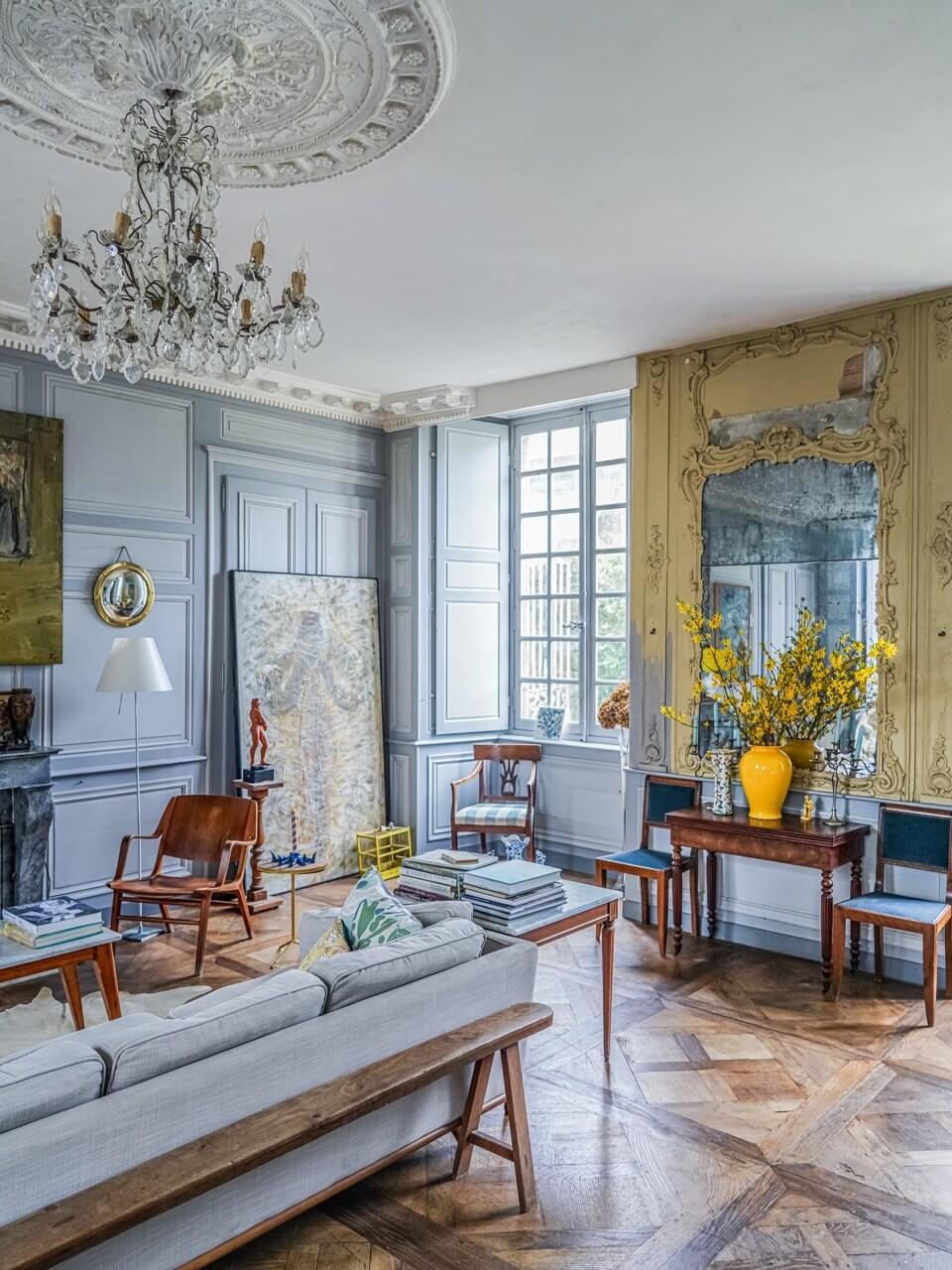
7. The Blue Salon at Château du Fresne, an artist residency in Bourgogne, France, where seventeenth-century interiors sit alongside contemporary art commissions. A one-month residency at Château du Fresne is one of the residency prizes in the .ART Award 2026.
