

Amin Jaffer on the Indian Pavilion 2026
Amin Jaffer
“Venice Biennale Portrait” is a series of interviews conceived and conducted by Mara Sartore, introducing some of the most anticipated figures in the contemporary art scene on the occasion of the 61st International Art Exhibition – La Biennale di Venezia. The series began before the inauguration of “In Minor Keys” under the title “Awaiting Venice Biennale 2026”. In both its phases, collectors, curators, artists, and directors engage in conversations exploring their roles, upcoming projects, and their relationship with Venice.
In this conversation, Mara Sartore meets Amin Jaffer, curator of the Indian Pavilion, in his home in Venice to discuss the vision behind the national participation at the 2026 Biennale, “Geographies of Distance, Remembering Home”. Drawing from his own experience within the Indian diaspora, Jaffer reflects on migration, memory, and the emotional meaning of home through the work of five artists whose installations explore textiles, architecture, performance and landscape. The conversation also touches on Venice as a place of inspiration and cultural exchange, addressing the city’s fragile balance between international cultural growth and the preservation of its local community and identity.
MS – What first brought you to Venice, and what eventually led you to make the decision to live here?
AJ – Venice has been part of my life since I was a small boy. I first came here when I was nine years old with my parents, and already I felt a deep attachment to the city. As a teenager, and later as a writer and curator, I kept returning to Venice. I would often rent apartments here for long periods in order to conceive and realise projects, and to write books. I formed friendships with Venetians and with people in the cultural world, and I often thought about buying something here and eventually coming to live in Venice. It was during COVID, when Europe truly stopped, that life became very difficult and challenging. Many Venetian friends said to me, “Why don’t you take this opportunity to come to Venice and finally realise your Venetian dream?” And I did. I found myself falling even more deeply in love with the city. I rented an apartment in Palazzo Loredan and began to appreciate the rhythm of the city, its immediacy, and its relationship with nature — of course with architecture and culture as well, but also with the sense of community among people who have consciously chosen Venice as a place to live. That includes international people with a deep commitment to the city, but also local people who decide to stay rather than move to Mestre or elsewhere. Very quickly I formed strong bonds because we shared a common vision of how to live. Nature plays a very important role in life here. We are surrounded by water, within the ecosystem of the lagoon, and immersed in a remarkable composition of architecture and beauty.
For me, Venice satisfies many aesthetic and human needs: the sense of community, the democratic nature of a city where everyone walks, and the ease with which you encounter friends in the campo. There is an immediate sense of belonging. There is also a market only a few minutes away, where every morning boats arrive from the outer islands carrying fish and vegetables. And there is an extraordinarily rich cultural life — not only in contemporary art, but also in historic art, painting, music, and literature.
Venice remains an incubator for creators of every kind. It continues to inspire and attract people working in culture year after year. It is one of the few cities in the world that anyone interested in the creative arts and visual culture feels compelled to visit. It is like a well of inspiration.
MS – We are approaching the local elections at the end of May, and there is a widespread perception that Venice is steadily losing inhabitants year after year. On one side, the city is experiencing a flourishing cultural moment, with new foundations opening and international collectors, curators, and patrons choosing to live here. On the other, many ordinary Venetians are leaving because housing has become inaccessible or unaffordable. Since you have now been living here continuously since 2020, how do you envision the future of Venice? How can these different realities coexist, and what kind of city do you imagine Venice becoming in the years ahead?
AJ – I think Venice continues to be a source of inspiration and a place of enormous importance. Maintaining a community of true Venetians — families, artisans, students — is critically important. Of course, this is a challenge for the local municipality, for the Italian state, and indeed for the wider world, because Venice belongs to all humanity. We all have a role to play in preserving the city — not only its environment, but also its social fabric — and in creating a sustainable community that keeps Venice alive. Venice is a living organism, and it depends on the support and participation of people who actually live here. We want to see schools continue, and artisan workshops continue. During my own lifetime, I have seen small antiquaries, silversmiths, leather workshops, and wood workshops disappear from central Venice. These are larger policy questions about what a city and a municipality can do to create an environment that attracts people, enables them to stay, and gives them the support they need — whether through controls, incentives, or subsidies.
Clearly, I believe Venice is important for all humanity, and I think it deserves international attention.
MS – As Director of the Al Thani Collection and curator of the Indian Pavilion at the 2026 Biennale, you are navigating two important institutional roles simultaneously. Could you tell us more about the concept behind the pavilion, “Geographies of Distance, Remembering Home”, and how the project gradually took shape over time?
AJ – Yes. Alongside my role as Director of the Al Thani Collection, I have been working on the Indian Pavilion as part of an important initiative supported by the Indian government. The theme, “Geographies of Distance, Remembering Home”, is deeply autobiographical. I come from an Indian family that has lived in Africa for many generations, so I grew up with a very strong sense of Indian identity while being geographically far away from India. In fact, I did not visit India until I was twenty-three years old. My experience — that of the Indian diaspora — is very common. Wherever you go in the world, you encounter Indian communities. People migrate for many reasons: business, education, marriage, economic opportunity. Yet we know that since ancient Mesopotamia there have always been Indian communities living outside India.
Today, India has an enormous global presence. It is one of the world’s largest economies and the most populous nation. Its culture — music, cinema, food, textiles, fashion — is felt everywhere.
With this pavilion I wanted to address two ideas. The first concerns people like myself — Indians living outside India — and how we maintain a sense of identity and belonging despite geographical distance. Whether in America, Hong Kong, Africa, or Britain, even after several generations, many Indians retain strong links to India through language, cuisine, dress, and cultural values. At important moments in life, no matter how assimilated they may seem, they often reconnect with that Indian identity. I was very interested in this idea of distance and the memory of home.
The second idea relates to India itself. India is currently experiencing extraordinary economic and demographic growth, along with major technological development. Cities are transforming at an incredible pace: neighbourhoods are rebuilt, new infrastructure appears, and places change so rapidly that after only a few years they can become almost unrecognisable.
MS – How do you define home when the physical place itself no longer exists, or has been completely transformed?
AJ – We are speaking here in Venice, which is remarkably preserved, but there are cities such as London where entire areas can change dramatically within a short period of time. In India, this process is happening in an accelerated way.
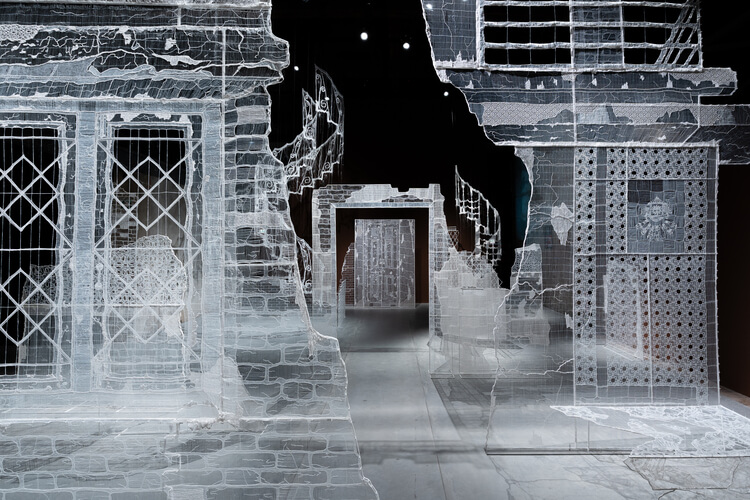
The inspiration for the project comes from the work of Sumakshi Singh. She grew up across India because of her father’s work and lived in eleven different Indian states. The one constant in her life was her grandparents’ house in Delhi, where the family gathered during holidays.
Her grandmother loved embroidery, and all the women in the family — including Sumakshi — learned to embroider together. It became a shared family activity and a form of connection. After her grandparents died, however, the family decided to demolish the house. This was partly the result of demographic pressure and urban development. In cities like Delhi, a family house with a garden has become an enormous luxury, and often such spaces are replaced by apartment buildings.
For Sumakshi, the demolition of the house was deeply painful because it felt as though her childhood memories were being erased. In response, she recreated the entire house in thread and embroidery — a life-size version made entirely through stitched work.
MS – Listening to these projects, one senses that “home” is never presented simply as a physical place, but rather as something fragile, emotional, and constantly transforming through memory, migration, and loss. What would you like visitors — especially those who have experienced displacement or multiple forms of belonging — to reflect upon after encountering the pavilion?
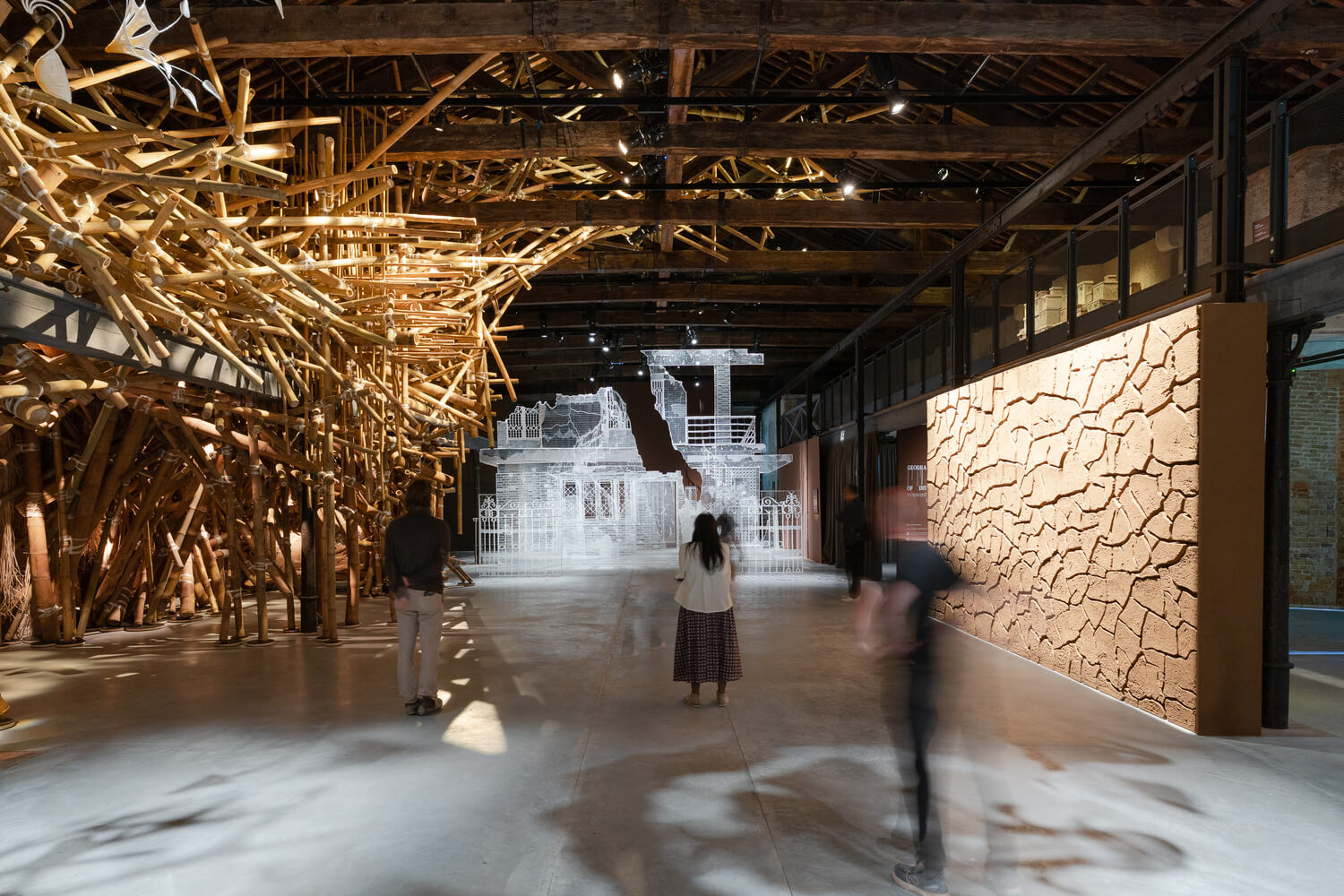
AJ – The idea is that the house is presented as a vestige of what it once was. You walk through it on the ground floor: you can look up and see staircases and walls, but they are all made of thread. Of course, it is deeply symbolic, because India is a major textile-producing economy, and textiles are closely tied to its history of independence. India continues to play a very important role in textile production, so the work is highly evocative. On one level, you have this thread version of a house. Thread is, on the one hand, a supple and fragile material — something that can easily be broken — but it also has an extraordinary capacity to create architecture. It reflects Indian tradition very directly, because we have a strong culture of embroidery, stitching, knitting, and weaving. This was really the core project that inspired the theme of the pavilion, Geographies of Distance, Remembering Home, because Sumakshi remembered home, and in doing so she recreated it. She lovingly reconstructed the family home she had lost.
Alongside this, the work of Bala, an artist based in Tamil Nadu who often works with organic and natural materials, addresses the question of soil — the earth beneath our feet. He has created two panels of fractured soil that reflect the fragility of the earth and the dialogue between soil, water, and air. We often think of home without considering the ground beneath us.
Ranjani Shettar has created a remarkable suspended garden with exaggerated, fantastical plant forms. These are imaginary forms, drawn from her emotional response to nature. It is a complex installation of suspensions — I believe there are fifty-two sculptures with seventy-two suspension points — arranged almost like a musical composition.
The fourth artist is Tashi. He comes from Ladakh, where traditional architecture uses vernacular materials such as wood and mud, built into the mountainside with thick walls to retain heat in winter and keep interiors cool in summer. This type of architecture is now being replaced by new construction using steel, concrete, and glass.
The fifth project is by Asim Waqif, who works with recyclable materials, particularly bamboo. He has created a monumental bamboo installation evoking scaffolding.
Taken together, the five projects reflect both the emotion of remembering home and the anticipation of the future. They suggest that home is not a fixed physical place, but an emotional condition — something constantly reworked through memory, relationships, language, food, music, and objects.
MS – Looking at the projects presented in the pavilion, two strong leitmotifs emerge: textiles and performance. There seems to be a particular attention to the body, gesture, and the act of making by hand. Was this material and performative dimension something you consciously wanted to foreground?
AJ – Yes, fibre is certainly at the basis of the pavilion, but performance is also an important element. The pavilion is realised by the Ministry of Culture, in partnership with two Indian institutions: the Nita Mukesh Ambani Cultural Centre and the Serendipity Arts Foundation. Both have a strong tradition in the performing arts, as well as in curatorial work spanning both static and performative practices.
In addition to the artworks presented inside the pavilion, we will also be rolling out a performance programme across Venice. We will have music on boats and performances in public spaces. The programme will run during the opening week and then across four or five additional periods throughout the Biennale. We have deliberately aligned these moments with key cultural periods in Venice — such as Homo Faber and the Festa del Redentore — when the city is especially active and full of international visitors. The intention is not to create a project that exists only within a single space and then disappears, but rather to build bridges and long-term relationships within Venice itself.
MS – How did you navigate the relationship between your role as Director of the Al Thani Collection and your role as curator of the Indian Pavilion? In particular, when it came to selecting the artists, how did you approach the question of curatorial independence?
AJ – With the India Pavilion project I’ve had an artistic and curatorial liberty, bearing in mind that I am deeply conscious of the commissioners, partners and stakeholders involved, ensuring that they endorse the artist projects and the underlying message.
The important thing is that anyone who knows me knows I am an obsessive workaholic. So during this very busy Biennale period, I was also able to oversee our project in Paris. We presented a very beautiful exhibition called “Joyaux Dynastiques”, the most successful show we have ever done, dedicated to dynastic jewels of power. And I am now completing the catalogue for our next exhibition, which opens in Paris in early July.
MS – This project has clearly been developing over a long period of time. At what moment did the pavilion truly begin to take shape for you?
AJ – The concept had been developing in my mind for quite a long time. Being of Indian origin and living in Venice, I have to admit that it had always been my dream to work on the India Pavilion. I wanted to create a pavilion with a distinctly Indian materiality and identity. I had been thinking about the content for many years, but it was only after In Minor Keys was announced as the Biennale theme that the idea of home really crystallised for me.
MS – Speaking about the idea of home, do you now consider Venice your home as well?
AJ – Yes, absolutely. I love Venice. We have to remember that Venice is a ville portière — a port city. Historically, it has always been a place of international communities, traders, and merchants. For centuries it was perceived as the gateway to the East, the gateway to the Orient. So yes, I feel very much at home here. It is a city that I have embraced and that has embraced me in return. In many ways, Venice represents core human values and a lifestyle that I deeply endorse. The sense of community, the experience of seeing the same people every day — all of this creates very strong bonds. That is why so many people continue to come here: because we are immersed in beauty, architecture, nature, music, and literature. Venice remains a city with an extraordinary cultural and human richness.
Images:
Dr. Amin Jaffer, pictured with Ranjani Shettar’s Under the same sky. Pavilion of India at the 61st International Art Exhibition – La Biennale di Venezia 2026 © Andrea Avezzù
Sumakshi Singh, Permanent Address. (2026). Pavilion of India at the 61st International Art Exhibition – La Biennale di Venezia 2026. © Joe Habben
Skarma Sonam Tashi, Echoes of Home (2026). Pavilion of India at the 61st International Art Exhibition – La Biennale di Venezia 2026 © Andrea Avezzù
Skarma Sonam Tashi, Echoes of Home (2026). Pavilion of India at the 61st International Art Exhibition – La Biennale di Venezia 2026 © Andrea Avezzù
Ranjani Shettar – Under the same sky. Pavilion of India at the 61st International Art Exhibition – La Biennale di Venezia 2026 © Joe Habben
Ranjani Shettar – Under the same sky. Pavilion of India at the 61st International Art Exhibition – La Biennale di Venezia 2026 © Luca Zambelli
Asim Waqif, Chaal. Pavilion of India at the 61st International Art Exhibition – La Biennale di Venezia 2026 © Joe Habben
Asim Waqif, Chaal. Pavilion of India at the 61st International Art Exhibition – La Biennale di Venezia 2026 © Joe Habben
Alwar Balasubramaniam, Not Just for Us (2026). Pavilion of India at the 61st International Art Exhibition – La Biennale di Venezia 2026 © Andrea Avezzù
Alwar Balasubramaniam, Not Just for Us (2026). Pavilion of India at the 61st International Art Exhibition – La Biennale di Venezia 2026 © Andrea Avezzù
India Pavilion at the 61st International Art Exhibition, La Biennale di Venezia. © Joe Habben
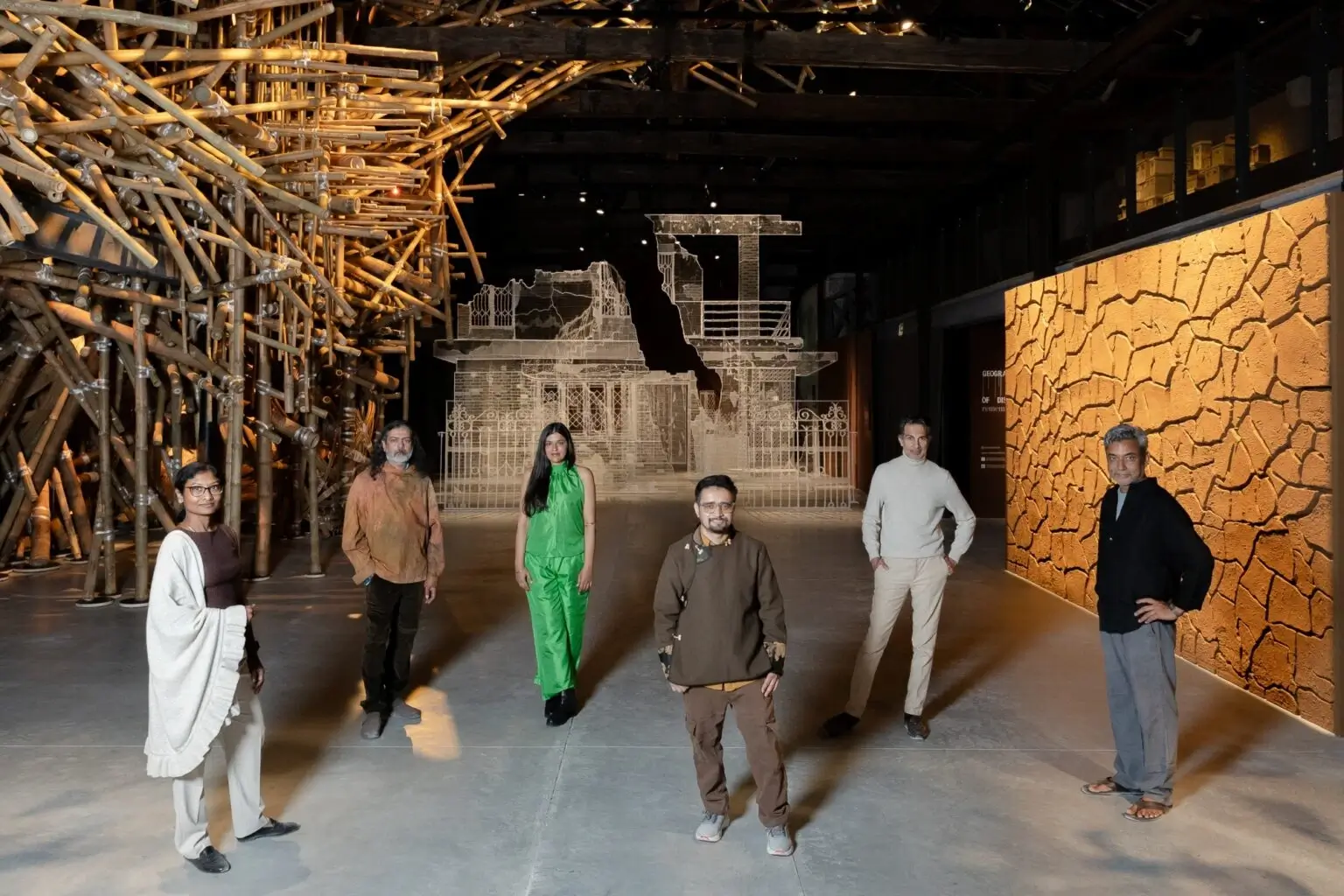
Artists Alwar Balasubramaniam, Sumakshi Singh, Ranjani Shettar, Asim Waqif, and Skarma Sonam Tashi. © Joe Habben


